The overall situation and technological development trend of the new energy automobile industry!新能源汽车产业整体态势和技术发展趋势!
The overall situation and technological development trend of the new energy automobile industry!
Recently, the China Electric Vehicle 100 Forum (2023) expert media exchange meeting was held in Beijing. Ouyang Minggao, academician of the Chinese Academy of Sciences, professor of Tsinghua University, and vice-chairman of the China Electric Vehicle 100, was specially invited to attend. Hot issues such as the price trend of battery raw materials, the development trend of the new energy vehicle industry, and the technical route were answered by reporters. The following is summarized according to the contents of the scene.
Question: In 2022, the price of power batteries will rise rapidly, but it has fallen back somewhat. What is the overall trend of power batteries this year?
Ouyang Minggao: Last year, the biggest factor affecting new energy vehicles was the rise in lithium prices. The main reasons were strong demand, short supply, and supply delays caused by the impact of the epidemic. In 2022, my country's electric vehicles will double compared with the previous year, and power batteries will increase by 150%. The total volume is already quite large. On this basis, the growth rate in 2023 will be relatively reduced. The growth rate of electric vehicles is expected to drop to 30%-40%. The total production and sales will be close to 10 million. About 50%, the total shipment is close to 1 billion kWh. Under the background that the growth rate of pure electric vehicles will decrease, and the proportion of plug-in hybrid and extended-range electric vehicles will increase, the average battery loading of new energy vehicles will decrease, and the tense demand situation will be greatly alleviated.
From the perspective of the supply side, the production capacity of lithium ore mining has been accelerated; in the long run, the reserves of lithium resources are sufficient and the mineable volume continues to increase, and the price increase has also brought opportunities for the battery material recycling industry; in the longer term, recycled resources will gradually completely replace the original resource requirements.
The price of lithium resources is mainly determined by supply and demand. At present, the price of lithium has returned to about 450,000, and it is expected to further return to 350,000-400,000/ton in the second half of this year, and the overall supply and demand will be balanced throughout the year. In the future, a more reasonable price balance point may be around 200,000/ton. Lithium prices cannot be too low if the battery recycling industry is to develop.
How to judge the overall situation and technological development trend of the current new energy automobile industry?
Ouyang Minggao: The development of the new energy automobile industry in 2022 will exceed expectations because of the high-quality development of the industry. In terms of product competitiveness, new energy passenger vehicles have covered all models, especially mainstream models that have entered 100,000 to 200,000. The results of evaluation and testing institutions are also quite encouraging. The overall evaluation of China's own brand of new energy vehicles is higher than that of fuel vehicle brands. The winter performance test has greatly improved, and heating and cold start are better than fuel vehicles. Not only in the domestic market, the export is also very good, and the price continues to increase. my country's power battery industry continues to lead the world, and 70% of power batteries are made in China.
We not only build factories abroad, but also benefit from intellectual property rights. Regardless of the new energy vehicle industry or the power battery industry, industrial competition is intensifying, structural adjustment is accelerating, and the overall competitiveness of the industry is strengthening. In this process, domestic consumers' trust in self-owned brands has continued to increase, and some high-quality companies have continued to emerge.
In terms of technology, there are five highlights in summary:
First, the power battery industry leads the world with technological innovation, and is developing in the direction of low-carbon, high-end, and intelligent. The innovation of blade battery technology has enabled China to lead the trend of lithium iron phosphate batteries installed in passenger cars. Power batteries are constantly impacting the upper limit of specific energy, from 300 Wh/kg to 350 Wh/kg, and even to 400 Wh/kg; in the past, the ternary 8 series did not dare to do it, and now they are marching towards the ternary 9 series; in addition, various manufacturers The company's semi-solid batteries are also about to start loading.
Second, infrastructure technology progress is accelerating, including battery replacement technology and overcharging technology. The super charging standard has been released, and all manufacturers of 350 kW super fast charging stations have begun to deploy, and will continue to be implemented in the next few years. Super fast charging can recharge 200 kilometers in 5 minutes. In terms of slow charging, the research and development of orderly charging and two-way charging are in place, and large-scale demonstrations are expected to begin soon. With the increasing number of electric vehicles, urban power grids are being forced to carry out vehicle-network interaction reforms. This speed is beyond everyone's expectations.
Third, pure electric heavy-duty truck and fuel cell heavy-duty truck technologies have gradually matured and entered the stage of commercial explosion. 2022 is a landmark year for the electrification of heavy trucks, with sales of electric heavy trucks reaching 25,500 units. Among the pure electric heavy-duty trucks, battery-swapping heavy-duty trucks account for about half, indicating that the business model of battery-swapping heavy-duty trucks has been tested by the market and is economical to compete with traditional fuel vehicles. This year, electric heavy trucks will also grow at a high speed, and it is expected to reach 50,000 units, achieving a growth rate of 90%-100%. Fuel cell heavy trucks sold 1,250 units last year. Although the volume is not large, the growth rate is expected to be very fast, and its cost has entered a rapid decline channel, which has the possibility of marketization. In 2022, the cost of fuel cells can reach 3,000 yuan per kilowatt, and it is expected to drop to less than 1,000 yuan per kilowatt by 2030. Electric heavy-duty truck technology includes not only the power system, but also the entire chassis, and the skateboard chassis may be the first to be applied to commercial vehicles.
Fourth, the smart driving technology of electric vehicles is developing rapidly. It is expected that in the first half of 2023, city navigation assisted driving will be launched one after another. In order to obtain big data, car companies must sell a large number of smart assisted driving electric vehicles, especially city assisted driving, so this year car companies may rush to market, which is also an important technological trend.
Fifth, we must continue to promote business model innovation, because technological innovation requires business model innovation to be promoted on a large scale. The price of electric vehicles is still the core of market competition. The solution depends on technology on the one hand and business model on the other. The battery is the core pivotal device in the entire new energy ecology. It is not only the core component of the new energy vehicle, but also the energy storage unit of the power grid. Batteries are centrally operated in the hands of merchants. Using them to store energy to obtain additional income can reduce the burden on customers, reduce the cost of complete vehicles, and increase the penetration of the electric vehicle market. In addition, it can also generate income through the interaction of batteries, photovoltaics, and power grids, and generate new new energy industries.
Question: Regarding plug-in hybrid and extended-range electric, which route is more in line with market demand? Is it more helpful to the development of China's new energy automobile industry? Will the rapid rise of plug-in hybrids and extended-range electric vehicles, especially in the market environment after the cancellation of subsidies, affect the development of pure electric vehicles?
Ouyang Minggao: Plug-in hybrid and range-extending hybrid belong to the same system technically. Range-extended electric is generally equivalent to pure electric, and the mileage is increased by the fuel generator set when the power is in short supply. The plug-in hybrids sold in China now basically use electricity when there is electricity, and use oil when there is electricity, that is, both are pure electric vehicles when there is electricity. It’s just that in the state of power loss, the extended range enters the series hybrid working mode, and the engine does not directly drive the wheels but generates electricity. There are many operating modes of plug-in hybrid, which can be connected in series or in parallel. It is a hybrid mode with stronger selectivity and higher requirements for technical level. The main difference between the two is that when the range-extending electric vehicle loses power, the fuel consumption will be relatively high if driving on the highway.
If there are not many long-distance extended-range electric running, the occasional high fuel consumption is not a problem. If it is a plug-in hybrid mid-level mainstream car, there is only one car in the family, and the requirements for cost performance are relatively high. Because the pure electric cruising range of the general plug-in hybrid is a little lower than that of the extended-range electric. In the past, batteries were expensive and used too little to meet the acceleration requirements of cars. Now that the power of batteries has increased, cost control will be better. In fact, there is not much difference between the two, and it is a personal choice for consumers.
Now, the price of the entire electric vehicle is high, the cost of the battery is also high, and the subsidy is in the stage of declining and stopping. I think plug-in hybrid and extended-range electric should be an upward trend. In the next few years, in the entire new energy vehicle The proportion will increase. There will be more mainstream models for 100,000-200,000 households, especially plug-in hybrid models; for high-end models of 300,000-400,000 because of too many batteries, extended-range electric and plug-in hybrids will also be an important issue. It is also possible to account for 30%-35% of the market.
But in the medium and long term, there is a lot of room for innovation in battery business models and technologies. The overall cost of battery purchase and use will continue to decline; with the popularization of slow charging piles and the deployment of super fast charging on expressways, charging will be more convenient than refueling in the future, and electric vehicles will run faster than plug-in hybrids and extended-range electric vehicles in urban areas. Good; the development of new energy power and the implementation of vehicle-network interactive technology enable electric vehicles and batteries to be used as energy storage devices to obtain benefits; and under multiple factors such as fuel consumption emission requirements and stricter carbon tax management, the advantages of pure electric vehicles are will become more and more obvious.
It is expected that after 2030, plug-in hybrid and extended-range electric vehicles will gradually withdraw from the market. For example, the European Union's 2035 ban on the sale of fuel vehicles includes these two models.
The new round of scientific and technological revolution and industrial transformation is booming, and the technology integration of automobiles and energy, transportation, information and communication is accelerating. Electrification, intelligence, and networking have become the development trend and trend of the automobile industry. The core battlefield of technological dominance. The next ten years will be the most intense competition in the field of new energy in the world, and it will also be a new technological revolution sweeping the world. The winner will become the leader of the global new energy industry chain in the future. With the global electrification under the superimposed super subsidies of European carbon emission policy, China's double credit policy and the acceleration of high-quality models on the supply side, and the high investment plan of new energy in the United States, the production and sales of the new energy industry will continue to maintain high growth in the future.
Prospects of domestic new energy vehicles: in the ascendant, global racing
Over the past ten years, the government has increased support for my country's new energy vehicle industry and continued to subsidize it. Until 2021, the subsidy standard for new energy vehicles will be reduced by 20% on the basis of 2020. After ten years of hard work and development, my country's new energy automobile industry has formed a relatively complete industrial chain, and the market has begun to take shape. At present, my country's new energy vehicles have entered a new stage of "market + policy" two-wheel drive development.
According to statistics from the China Association of Automobile Manufacturers, in 2020 China will achieve sales of 1,367,315 new energy vehicles, a year-on-year increase of 13.35%, and the average annual compound growth rate in the past five years has been 32.80%. "Half of the country", the production and sales of new energy vehicles in my country have ranked first in the world for six consecutive years.
Looking forward to the future, under the background of the national grand strategy, my country's new energy vehicles are at the right time and have unlimited prospects. In 2020, the penetration rate of the global new energy vehicle market is 4.15%. By July 2021, the penetration rate of new energy vehicle sales in my country will reach 16.5%, and the market size still has a large room for growth.
Domestic new energy vehicle policy: preemptive strikes, ahead of other countries
The future industrial layout of new energy vehicles can be described as a place where all the heroes will compete. my country proposes that the sales penetration rate of new energy vehicles will reach 25% by 2025, and California of the United States proposes that the sales penetration rate of new energy vehicles will reach 15% by 2025. Some EU countries have even more aggressive goals. For example, Norway proposes to achieve 100% penetration rate of new energy sales by 2025; Denmark and Ireland to achieve 100% penetration rate by 2030; 100%; by 2030, the cumulative sales of new energy vehicles in Germany will be 7 million.
Facing the competition for the market share of new energy vehicles, various countries are competing to introduce supportive policies. At present, the penetration rate of new energy electric vehicles in the United States is only 3%, which is far lower than the 10% and 15% in China and Europe. In order to catch up, U.S. President Joe Biden signed an executive order, setting a target that electric vehicles account for 50% of new car sales by 2030. This executive order marks that the United States has raised the new energy vehicle industry to the height of the national strategy, which will further accelerate the acceleration of the global vehicle electrification process.
And our country has given strong support in terms of policy:
01
In April 2020, the Ministry of Finance issued the "Notice on Improving the Financial Subsidy Policy for the Promotion and Application of New Energy Vehicles", extending my country's new energy vehicle subsidy policy for 2 years to achieve a stable transition;
02
In September 2020, the National Development and Reform Commission and other four departments issued the "Guiding Opinions on Expanding Investment in Strategic Emerging Industries", emphasizing the acceleration of the leapfrog development of the new energy industry, the research and development of core technology components, the construction of charging and swapping stations for new energy vehicles, and the implementation of intelligent networked vehicles. road tests and demonstrations;
03
According to the "New Energy Vehicle Industry Development Plan (2021-2035") issued by the General Office of the State Council in 2020, by 2025, my country's new energy vehicle sales will account for about 20%, and by 2035, pure electric vehicles will become the mainstream of new sales vehicles. It is estimated that from 2021 to 2025, the average annual compound growth rate of new energy vehicles in China will be 34.42%; by 2025, highly autonomous vehicles will be commercialized in limited areas and specific scenarios; by 2035, highly autonomous vehicles will be applied on a large scale.
04
On July 30, 2021, the Political Bureau of the CPC Central Committee held a meeting. The meeting called for tapping the potential of the domestic market and supporting the accelerated development of new energy vehicles.
The trend of intelligence is unstoppable
Ouyang Minggao, an academician of the Department of Technical Sciences of the Chinese Academy of Sciences, said that with the increase in policy dividends and the advantages of broad market prospects, the new energy automobile industry will become a huge "outlet". The revolutionary development of technologies such as electrification, intelligence, and lightweight are the three core trends in the development of new energy vehicles.
Among them, an important fulcrum for domestic new energy vehicles to maintain their advantages is autonomous driving. The wave of autonomous driving is sweeping through the booming automobile industry, especially affected by the current epidemic. People in the industry generally believe that the L3+ automatic driving system will be the first to be applied in the field of commercial vehicles, and the automatic driving of heavy trucks will have a significant impact on modern transportation. The industry has brought about huge changes.
At the National People's Congress in 2018, many deputies to the National People's Congress also called for accelerating the development of autonomous driving technology from the legislative level. In recent years, national policies have continued to increase, and the commercialization of high-end autonomous driving for commercial vehicles has entered a critical period. Including the public release of relevant policies by the Ministry of Transport at the end of last year, which shows that "encouraging the demonstration application of autonomous driving and cargo delivery based on demand" will further promote the commercialization of commercial vehicle autonomous driving.
my country's road freight market ranks first in the world. According to data from the China Federation of Logistics and Purchasing, in the first half of this year, the total revenue of my country's logistics industry reached 5.7 trillion yuan, a year-on-year increase of 22.8%. Thanks to the application of automatic driving, on the one hand, the ratio of people to vehicles will be reduced, and the cost of drivers will be greatly reduced; on the other hand, the technology will get rid of human bad driving habits and greatly reduce fuel costs; Reducing the safety and efficiency risks caused by fatigue driving can be improved. With the development of the global autonomous driving industry to the final sprint stage of real mass production, the implementation of heavy truck automatic driving represented by the trunk logistics scene will usher in a broad market.
Academician Ouyang Minggao believes that China has been at the forefront of the world in terms of transportation electrification over the past two decades. China has a complete industrial chain and obvious cost advantages. Looking at the world, we will continue to maintain a leading position in electrification. In addition, my country also has obvious advantages in the world in low-carbonization, wind power, and photovoltaics. In terms of intelligence, China's informatization level ranks among the top in the world. This will become an important foundation for my country to maintain its leading position in the new energy and smart car industries.
Industrial chain advantages may bring high returns
China Society of Automotive Engineers believes that the current development of my country's new energy and smart car industry has achieved four advantages: first, the scale of the industry continues to expand; second, the technical level has been significantly improved; third, the strength of enterprises has been significantly enhanced; .
With the reshaping of the new energy vehicle supply system, the participants in the industrial chain have also undergone great changes, from traditional machinery suppliers to the coexistence of multiple types of suppliers such as electrochemistry, electronics, semiconductors, communications, and software. However, these emerging fields have not been monopolized by well-known international head companies in the United States and Germany. Domestic start-up companies and international competitors are still on the same technology and R&D starting point. At the same time, with the support of localization advantages and domestic substitution demand, we have the opportunity to break through and successfully achieve high-return growth.
Leading solid-state batteries will eliminate range anxiety
With the continuous improvement of lithium battery technology and new energy vehicle battery management system capabilities, pure electric passenger vehicles equipped with liquid lithium batteries are limited by their energy density bottlenecks, and it is difficult to further increase the cruising range; in addition, with higher specific capacity With the application of high-nickel ternary materials, the probability of safety accidents such as spontaneous combustion and explosion of traditional liquid lithium batteries may increase. The long mileage and high safety requirements of the battery are highlighted by the limitations of the performance of existing technologies.
Solid-state batteries are based on the use of solid-state electrolytes, and the positive and negative electrode materials and structural systems have been greatly optimized compared with traditional liquid batteries. The safety and energy density have been qualitatively improved, and the cost of mass production can be equal to that of traditional liquid lithium batteries. . Solid-state batteries have received widespread attention worldwide, and giant companies such as Toyota, BMW, Volkswagen, and Samsung have invested a lot of money in solid-state battery research. As early as 2018, the Japanese government announced that it will invest 10 billion yuan in research and development between 2018 and 2022 to restore its disadvantages in lithium batteries.
In recent years, Chinese scientific research institutions and related companies have made positive progress in solid-state batteries. According to reports, solid-state batteries are expected to start mass production in China within the next year.
LiDAR will be the key to autonomous driving
In February 2020, 11 ministries and commissions including the National Development and Reform Commission jointly issued the "Smart Vehicle Innovation and Development Strategy", proposing to realize the large-scale production of conditional intelligent driving vehicles (L3 level) in 2025, and to build a comprehensive Chinese standard car in 2035. The vision of intelligent vehicle system. The United States and Europe have also introduced a number of policies and bills to support the development of autonomous driving.
With the improvement of the level of autonomous driving, the driving assistance functions gradually increase, and the value of software and hardware such as perception, planning, decision-making, and chips increases significantly. According to the China Association of Automobile Manufacturers, the penetration rate of ADAS products in China is expected to reach 50% in 2020, and the market size is about 87.8 billion yuan. From ADAS to autonomous driving, the demand for hardware in the perception field increases, and the demand for bicycle perception hardware tends to stabilize after reaching the L3 level. Therefore, the penetration rate of L2+ level models has increased, and L3 level models have been gradually mass-produced. Ultrasonic radar, millimeter wave radar, lidar, and cameras are all options for hardware in the field of perception.
Compared with millimeter-wave radar, camera, ultrasonic radar and other solutions, lidar is more balanced in terms of reliability, detection distance, and night performance, and has certain advantages. By 2025, the global lidar market in this field will exceed $4.5 billion.
my country's layout in the lidar industry chain is relatively balanced, and the situation where the midstream is strong and the upstream is weak has been further improved, which will ensure that we maintain a relatively large advantage in the global lidar industry chain competition. Lidar is the key technical equipment for the realization of autonomous driving technology. China's standardized support policies in the field of autonomous driving have also helped the further expansion of the domestic lidar market. Our government is actively promoting the formulation of national standards in related fields, which not only lies in the upgrading of automotive products and technologies, but is more likely to bring about the reshaping of the value chain system of automobiles and related industries.
Autonomous driving is expected to be the first to be commercialized in the field of commercial vehicles
Nowadays, the wave of autonomous driving is sweeping through the booming automotive industry, especially affected by the current epidemic. People in the industry generally believe that the L3+ automatic driving system will be the first to be applied in the field of commercial vehicles, and the automatic driving of trucks will have a significant impact on The modern transportation industry has brought about huge changes. According to the latest analysis by market research firm Future Industry Insight, the global market value of self-driving trucks in 2020 is US$1.004 billion, and is expected to reach US$1.669 billion by 2025, with a compound annual growth rate of 10.4% from 2020 to 2025.
At the National People's Congress in 2018, many deputies to the National People's Congress also called for accelerating the development of autonomous driving technology from the legislative level. In recent years, national policies have continued to increase, and the commercialization of high-end autonomous driving for commercial vehicles has entered a critical period. Including the public release of relevant policies by the Ministry of Transport at the end of last year showing that "encouraging the demonstration application of autonomous driving in combination with demand" will further promote the commercialization of commercial vehicle autonomous driving.
my country's road freight market ranks first in the world. According to data from the China Federation of Logistics and Purchasing, in the first half of this year, the total revenue of my country's logistics industry reached 5.7 trillion yuan, a year-on-year increase of 22.8%. Thanks to the application of automatic driving, on the one hand, the ratio of people to vehicles will be reduced, and the cost of drivers will be greatly reduced; on the other hand, the technology will get rid of human bad driving habits and greatly reduce fuel costs; Reducing the safety and efficiency risks caused by fatigue driving can be improved. With the development of the global autonomous driving industry to the final sprint stage of real mass production, the implementation of heavy truck automatic driving represented by the trunk logistics scene will usher in a broad market.
The Rise of China's Independent Brands
2021 is an important year for the development of China's intelligent electric vehicles, and more independent car manufacturers will enter the game. In terms of brand, product, technological foresight, capital strength, and talent attraction, independent auto brands have differentiated competitive advantages in different dimensions compared with mainstream joint venture auto companies, and independent brands are expected to take the lead in the wave of automotive intelligence Advantage.
New economy companies represented by Baidu and Xiaomi have clarified their strategies for electrification and intelligent car manufacturing; traditional car companies represented by SAIC, GAC, Geely, BAIC, and Dongfeng have also gathered funds, talents, and resources to build smart, New electric car brands such as Aian, Jikrypton, Jihu, and Lantu; emerging car manufacturers represented by Weilai, Ideal, Xiaopeng, Weimar, Nezha, and Leapao have also delivered excellent volumes. The report card of production and delivery, and lead the new direction of the technology and market of the global automotive industry.
After decades of accumulation and development, my country already has a relatively complete industrial chain. No matter from product research and development, technological innovation, manufacturing of accessories and products, to market operation and service, etc., we have relatively mature experience. From the data point of view, in terms of users' preference for new energy brands, the attention of Chinese brand new energy is significantly higher than that of overseas mainstream brands. During the critical window period for the development of new energy vehicles, most overseas mainstream brands lagged behind in new energy deployments and lacked user appeal, while self-owned brands gradually emerged in some important areas.
It is foreseeable that a long period of time in the future will become a development period of the new energy and smart car new technology revolution. Whether it is in renewable energy, artificial intelligence, new materials, etc., China will experience a revolutionary leap forward and synergistic cross-border development. At present, we will not only usher in the big wind of my country's new energy and intelligent industries, but also create a miracle of the Chinese era of new energy intelligent vehicles.
With the emergence of a new round of technological revolution and industrial transformation, the new energy automobile industry has entered a stage of accelerated development. my country's new energy automobile industry, after years of continuous efforts, has significantly improved its technical level, improved its industrial system, and greatly enhanced its corporate competitiveness, showing a good situation of "double improvement" in market size and development quality.
Especially under the global goal of achieving "dual carbon", the development of new energy has received more attention because it helps reduce greenhouse gas emissions, cope with climate change challenges, and improve the global ecological environment. At the same time, through the country's cultivation of the entire industry chain of new energy vehicles for many years, all links have gradually matured, rich and diversified new energy vehicle products continue to meet market demand, and the use environment is gradually optimized and improved. New energy vehicles are becoming more and more popular. Be recognized by consumers.
The development history of my country's new energy automobile industry
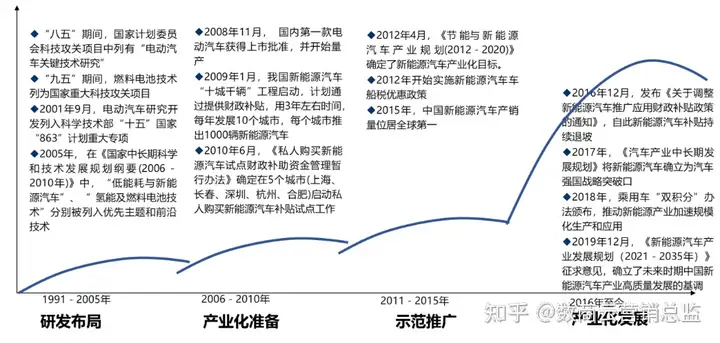
In the 1990s, my country realized the outstanding contribution and role of new energy vehicles in alleviating the energy crisis and environmental governance, and gradually launched incentive policies for the research and development of new energy vehicles. After experiencing the R&D layout during the "Tenth Five-Year Plan", the industrialization preparation during the "Eleventh Five-Year Plan", and the demonstration and promotion during the "Twelfth Five-Year Plan", my country's new energy automobile industry has passed the formation period of rapid development of technology and industrial chain. Since 2016, my country's new energy automobile industry has begun to take shape and entered a growth stage. From the perspective of industry life cycle theory, capacity expansion, technological innovation, product upgrading, and management capability improvement have become the labels of the growth stage of my country's new energy vehicle industry, which also shows that my country's new energy vehicle industry is changing from high-speed development to high-quality development.
Chart 1: Development History of my country's New Energy Automobile Industry
policy development stage
The evolution of my country's new energy vehicle industry policy can be roughly divided into three periods:
Emerging period (2001-2008): During this period, related concepts such as new energy vehicles were proposed, focusing on the production process of new energy vehicles and formulating industry standards. However, at this stage, the state has not promulgated specific fiscal and taxation policies to support the development of new energy vehicles. The representative policy is the "Notice on Adjusting the Structure of the Automobile Industry". The policy sets out the future development plan for new energy vehicles.
Promotion period (2009-2014): During this period, the government introduced relevant subsidy policies for new energy vehicles, and at the same time started the demonstration operation project of new energy vehicles, and new energy vehicles were officially launched. At this stage, the pilot projects of demonstration and promotion are being further promoted and deepened, and policies to support the new energy automobile industry have been introduced continuously, gradually forming a complete industrial policy system. The representative policy is the "Notice on Carrying out the Demonstration and Promotion of Energy-saving and New Energy Vehicles".
High-speed development period (2015-present): The industrial policy in this period is similar to that in the promotion period, involving the improvement of main aspects such as promotion pilots and policy subsidies. Higher requirements are placed on the power battery. Since 2015, the subsidy standards for the new energy vehicle industry have been continuously adjusted, showing a trend of increasing technical thresholds and decreasing subsidy quotas. The representative policy is the "Notice on Financial Support Policies for the Promotion and Application of New Energy Vehicles from 2016 to 2020" jointly issued by the four departments. The release of this policy marks that the new energy vehicle industry policy has entered a new stage. The subsidy policy for the promotion and application of new energy vehicles will continue to be implemented from 2016 to 2020, and the subsidy will decline year by year.
Development Status
First, sales of new energy vehicles have shown explosive growth in recent years.
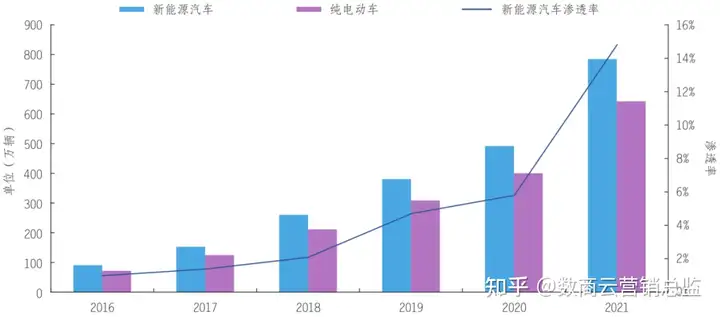
At present, the development of new energy vehicles has shown a new stage of development from policy-driven to market-driven. In terms of sales volume, the sales volume of new energy vehicles in my country will increase from less than 10,000 in 2010 to 3.3 million in 2021. In terms of sales volume in 2021, China has the world's largest new energy vehicle market, roughly twice the size of the entire European market, and about five times the size of the US market. At the same time, the penetration rate of new energy vehicles in China's passenger car market will increase rapidly from 2.4% in 2017 to 16.0% in 2021. New energy vehicles are becoming more and more popular among mainstream mass consumer groups.
Second, the market share of head manufacturers is highly concentrated.
Judging from the data on retail sales of new energy passenger vehicles, the current concentration of leading manufacturers is relatively high. The sales volume of the top 15 companies in the retail sales of new energy vehicle manufacturers reached 2.44 million units in total, accounting for a large proportion of the annual sales of new energy vehicles. Among them, the companies with retail sales of new energy passenger vehicles exceeding 200,000 include: BYD Auto , SAIC-GM-Wuling, Tesla China. The retail sales of these three companies accounted for about 55% of the top 15 auto retail sales. Xiaopeng, Weilai, and the new car-making forces have ideal retail sales of 90,000 to 100,000.
In terms of growth rate, the retail sales growth of the top 15 companies in the retail sales of new energy passenger vehicles all increased by more than 100%. Among them, there are 4 companies with retail sales growth of more than 200%, namely Hezhong Automobile, Changan Automobile, and Xiaopeng Automobile. Cars, BYD Auto. In terms of new car-making forces, the growth rates of Xiaopeng Motors and Hezhong Motors both exceeded 200%, and Hozhong Motors even exceeded 350%. In terms of sales volume and growth rate, BYD Auto ranks high in both retail sales volume and growth rate. On the whole, both traditional car companies and new car manufacturers will perform well in the field of new energy vehicles in 2021.
The third is the rapid growth of charging and swapping infrastructure.
In 2021, my country's charging and swapping infrastructure will grow relatively rapidly, and the market structure will present a relatively concentrated situation. According to data released by the China Electric Vehicle Charging Infrastructure Promotion Alliance, the increase in charging infrastructure in my country will reach 936,000 units in 2021. As of the end of 2021, the number of charging infrastructure in the country will reach 2.617 million units, a year-on-year increase of 70.1%. In terms of public charging infrastructure operating companies, there are 13 companies nationwide that operate more than 10,000 public charging piles. These 13 operators account for 92.9% of the total charging pile operations in the country. There are 4 companies operating more than 100,000 charging piles, namely Star Charging, Special Call, State Grid, and Cloud Fast Charging. The construction of charging stations and swapping stations is concentrated regionally.
At present, the scale of charging stations in economically developed areas such as the Pearl River Delta, the Yangtze River Delta, and Beijing-Tianjin-Hebei is relatively high, and the concentration of the number of unit charging stations in the top 10 provincial-level administrative regions with economic development is as high as 70.4%. There are a total of 1,298 swapping stations nationwide, and the concentration rate in Beijing, Guangdong, Zhejiang and other provinces and cities is as high as 74.6%. At present, the main power station operators are Weilai, Aodong New Energy, Hangzhou Botan and other enterprises. The scale of development of the power station is still small, still in the initial stage of development. On November 1, 2011, the State Administration for Market Regulation approved the release of the national standard GB/T40032-2021 "Safety Requirements for Battery Replacement of Electric Vehicles". This standard helps guide the product development of new energy vehicle companies, and is of great significance to the further development of the new energy vehicle industry in the field of battery replacement.
development trend
With the implementation of the "Double Carbon" policy, domestic economic transformation, the rapid development of green energy and the continuous deepening of energy supply-side structural reforms, coupled with the implementation of the "14th Five-Year Plan", a more favorable market environment has been created for the development of domestic energy storage. The energy industry will usher in a broader space for development.
First, the market-oriented driving force for the development of the new energy automobile industry will be further strengthened.
With the improvement of my country's new energy vehicle industry chain and supply chain system and the improvement of the competitiveness of new energy vehicle products, the supply level on the supply side of new energy vehicles will be further improved, and the degree of acceptance on the demand side will also be further improved.
Second, the penetration rate of new energy vehicles will further increase.
If the current development trend can be continued, my country may realize ahead of schedule the goal of new energy vehicle sales reaching about 20% of the total new vehicle sales by 2025 proposed in the "New Energy Vehicle Industry Development Plan (2021-2035)".
Source: Frost & Sullivan, Essence International
Third, pure electric vehicles are the main force for the development of new energy vehicles in my country.
From 2019 to 2021, the proportion of pure electric vehicle sales will continue to rise. The "New Energy Vehicle Industry Development Plan (2021-2035)" proposes that after 15 years of continuous efforts, pure electric vehicles will become the main force of new sales vehicles. At present, pure electric vehicles are the main force of new energy vehicles sold in my country. In the future, pure electric vehicles will become the main force of sales.
Fourth, small and medium-sized cities and rural areas may become new market spaces in the future.
With the deepening of the electrification of the automobile industry, the current central cities and rural areas with a low penetration rate of new energy vehicles may become new market spaces for new energy vehicles. In 2022, the National Development and Reform Commission and other departments issued the "Implementation Plan for Promoting Green Consumption" and proposed: in-depth development of new energy vehicles to the countryside, encouraging auto companies to develop and promote high-quality, low-cost, advanced and applicable new energy vehicles that meet the travel needs of rural residents, Promote and improve the rural operation and maintenance service system. The sending of new energy vehicles to the countryside may become an important phenomenon in the future development of the new energy vehicle industry.
Fifth, competition among new energy vehicle manufacturers may intensify.
At present, traditional car companies have shown strong pioneering capabilities in the field of new energy vehicles, and new car-making forces, as cutting-edge forces, have also shown a good level. The rapid development of the new energy automobile industry may also be accompanied by intensified competition, and the market concentration may further increase.
The sixth is the further development of charging and swapping infrastructure.
With the further growth of the number of new energy vehicles, it will bring major changes to the energy supply infrastructure of vehicles, and put forward higher requirements for the construction of charging and swapping infrastructure. This requirement is not only reflected in the quantity requirements of the charging and swapping infrastructure, but also reflects the more advanced charging and swapping technology innovation and the perfection of charging and swapping technical standards.
2023 China's electric vehicle charging and swapping and light power battery industry "Luban Award" selection activities officially launched
National Energy Administration "Power Peak Shaving Auxiliary Services" Subsidy Project
1. Joint establishment of a coordination mechanism
After research, the "Joint Work Office for Carbon Peak and Carbon Neutrality Promotion in the Power Supply Industry" (hereinafter referred to as: Joint Work Office) was established as a long-term industry service coordination agency. The organization is established in the Secretariat of the Power Industry Association.
2. Comprehensively carry out the action of "power peak shaving auxiliary service"
Combined with relevant national policies, real-time monitoring of electricity consumption data through the collection of enterprise adjustable loads, combined with price forecasts in the ancillary service market and statistical analysis of prices cleared by the State Grid, summarizing the price law of the ancillary service market, and using the price law as the basis for guiding user load adjustment , and combined with the actual operating conditions, adjust user loads, integrate users for power grid peak regulation, and finally realize the consumption of the remaining power of the power grid and ensure the safe and stable operation of the power grid.
The joint working office is now soliciting applications from the society and member enterprises and institutions across the country to participate in the "power peak shaving" user-side enterprises, and will issue the "Power Energy Saving Equipment Research and Record Form" to power users, and those who propose to participate in the "power peak shaving service" have been reviewed Enterprises that meet the conditions to sign the "Power Peak Shaving Service Agreement" will be awarded the title and plaque of "Double Carbon Economy Construction Demonstration Enterprise", and will be announced on the industry-specific website. The professional institutions entrusted by the Joint Work Office with "National Energy Administration Qualification" will directly provide financial subsidies.
3. Scope and Conditions for Participating in the "Double Carbon Economy Construction Demonstration Enterprise"
Any enterprise or institution with an independent legal entity (or its authorization) that applies to use its own adjustable load resources to participate in the response to the "auxiliary service for power grid peak regulation" can apply for the "Double Carbon Economy Construction Demonstration Enterprise".
▼ Declaration qualification and submission materials
1. All enterprises and institutions with independent legal entities can apply.
2. The scope of the adjustable load of the declaring enterprise includes (not limited to): industrial production electricity, electric heating and storage, electric energy storage, electric vehicle charging and other high energy-consuming enterprises and institutions.
3. Declare the power index of the enterprise: the capacity of the transformer is 1000KVA; the annual power consumption is about 1 million degrees.
4. The declaring enterprise needs to provide the "Electricity Fee Payment Notice" for three months to one year, fill in and submit the "Research and Record Form for Power Energy Saving Equipment".
Multi-sectoral efforts to speed up the construction of charging piles, energy storage and other facilities
Recently, multiple departments have made deployment arrangements around investment expansion. The National Development and Reform Commission proposed to accelerate the construction of charging piles, energy storage and other facilities. The Ministry of Agriculture and Rural Affairs held a special meeting to emphasize the expansion of effective investment in agriculture and rural areas. The Ministry of Transport clearly accelerated the construction of water transportation infrastructure...Experts said that since this year, effective investment has continued to expand , The growth rate of investment has increased compared with last year. With the introduction of more targeted policies and measures and the start of construction of major projects, the situation of stable investment growth is expected to continue.
Accelerating the construction of major projects is an important support for expanding domestic demand and stabilizing the overall economic market. In the first quarter of this year, the construction of major projects accelerated, effective investment continued to expand, and the contribution rate of gross capital formation to economic growth reached 34.7%, driving GDP growth by 1.6 percentage points.
Since the second quarter, more major projects have landed. At the end of April, my country's first major digital twin river basin construction project - the Yangtze River Basin full-coverage water monitoring system construction project started construction, with a total investment of 597 million yuan. On May 10, the safety construction project of the Kangshan flood storage and detention area in Poyang Lake, Jiangxi Province, one of the 150 major water conservancy projects in the country, started construction, with a total investment of 1.165 billion yuan.
Focusing on actively expanding effective investment, the National Development and Reform Commission has clearly proposed that it is necessary to effectively and orderly promote the construction of 102 major projects in the "14th Five-Year Plan" and other major economic and social projects, and strengthen the guarantee of land, energy use, and environmental impact assessment.
Transportation infrastructure has the characteristics of large-scale investment and quick results, and is one of the important areas for expanding domestic demand. On May 11, the Ministry of Transport held a meeting, proposing to focus on the leading role of major projects, actively coordinate and strengthen guarantees, and strive to expand effective investment in transportation.
According to Su Jie, deputy director of the Comprehensive Planning Department of the Ministry of Transport, a large number of major transportation projects are being promoted in an orderly manner. Provincial transportation authorities have successively formulated annual investment targets and tasks. The expected transportation investment scale of many provinces exceeds 300 billion yuan. "On the basis of maintaining the investment scale, we will further expand the effective investment in transportation, accelerate the approval and construction of key projects, strengthen the tracking, coordination, and scheduling of key projects, promote the implementation of projects in a scientific and orderly manner, prevent and resolve risks, and earnestly promote the steady growth. Give full play to the important role of transportation investment." Su Jie said.
Further release demand for agricultural and rural investment
Since the beginning of this year, investment in agriculture and rural areas has recovered steadily. Data show that in the first quarter, agricultural investment increased by 13.3% year-on-year, 8.2 percentage points higher than the overall investment growth rate.
"Currently, there are still many villages that need to be built and should be built, and these will greatly stimulate basic industries, and there is room for investment in agriculture and rural areas." Zeng Yande, chief agronomist and director of the Development Planning Department of the Ministry of Agriculture and Rural Affairs, said that according to estimates, the transformation of a Mu facility greenhouses can drive nearly 2 tons of steel consumption and 0.5 tons of cement. It is estimated that the demand for agricultural and rural investment will be nearly 15 trillion yuan in the next 5 to 10 years.
On May 5, the Ministry of Agriculture and Rural Affairs held the 2023 National Work Conference on Expansion of Effective Investment in Agriculture and Rural Areas, proposing to further release investment demand in agriculture and rural areas. Further strengthen research on major policies and project planning, and make good use of fiscal funds for supporting agriculture; further strengthen innovation in investment and financing models, and promote the interconnection and interaction between fiscal investment and financial and social capital; further strengthen the implementation of fiscal funds and project supervision to ensure that project funds are regulated Safe to use.
"We will improve the linkage mechanism between government investment and financial and social investment, and guide more funds to invest in construction areas such as high-standard farmland, storage and fresh-keeping cold chain logistics, modern facility agriculture, and improvement of rural living environment to form an effective investment-driven effect." Zeng Yande said.
The construction and transformation of large and medium-sized irrigation areas is an important basis for ensuring food security. On May 6, the Ministry of Water Resources held a meeting, proposing to speed up the construction of modern irrigation areas and broaden the financing channels for the construction of modern irrigation areas. Chen Mingzhong, director of the Rural Water Conservancy and Hydropower Department of the Ministry of Water Resources, said that this year, a number of large and medium-sized irrigation areas will be rebuilt and built. Up to now, more than 120 irrigation projects have been started.
Stimulate the vitality of private investment
To expand investment, the role of special bonds is prominent. This year's "Government Work Report" proposed that 3.8 trillion yuan of local government special bonds will be arranged this year.
"The Ministry of Finance is continuing to strengthen the management of special bonds and guide local governments to make good use of local government bond funds." Li Dawei, deputy director of the Budget Department of the Ministry of Finance, said that the debt limit will be issued to all localities in a timely manner, and urge local governments to do a good job in the issuance and use of new bonds in 2023. , continue to promote the construction of key projects, and promote the formation of physical workload as soon as possible. Strengthen the management of the negative list of special bond investment areas, and strictly prohibit the use of special bonds for various buildings, image projects, and political performance projects.
Private investment accounts for more than half of the investment in the whole society, and it is an indispensable and important link for expanding effective investment and stabilizing the economy. Experts believe that in order for government investment and policy incentives to effectively drive social investment, more private capital should be continuously encouraged and attracted to participate in the construction of major national projects and short-term projects to stimulate the vitality of private investment.
Meng Wei, spokesperson of the National Development and Reform Commission, said that the 14th Five-Year Plan's 102 major projects and key areas have been broken down into specific projects to attract private capital participation; more than 9,000 of the more than 50,000 projects promoted by various places since last year One has attracted the participation of private capital, involving private investment of 2.9 trillion yuan, and the enthusiasm of private capital to participate in major national projects and projects to make up for shortcomings has continued to increase. “We will work with relevant parties to establish a mechanism to encourage private capital to participate in major project construction, actively recommend attractive projects to private capital, continue to support major projects of private capital participation through policy-based development financial instruments, and increase support for private capital. Measures such as credit support for investment projects have enabled more private capital to participate in the construction of major national projects." Meng Wei said.
新能源汽车产业整体态势和技术发展趋势!
国产新能源汽车前景:方兴未艾,跑马全球
国产新能源汽车政策:先发制人,领先各国
智能化潮流势不可挡
产业链优势或将带来高回报
中国汽车工程学会认为,目前我国新能源和智能汽车产业发展取得了四个方面的优势:一是产业规模持续扩大;二是技术水平显著提升;三是企业实力明显增强;四是配套环境日益优化。
领先的固态电池将消除续航焦虑
激光雷达将成为自动驾驶的关键
自动驾驶有望最早在商用车领域得到商业化应用
中国自主品牌崛起
2021年,是中国智能化电动车发展的重要一年,更多自主造车势力入局。在品牌、产品、技术前瞻性、资本实力、人才吸引力等多个维度,自主汽车品牌相较主流合资车企均拥有不同维度的差异化竞争优势,自主品牌有望在汽车智能化浪潮中赢得领先优势。
随着新一轮科技革命和产业变革孕育兴起,新能源汽车产业进入了加速发展的阶段。我国的新能源汽车产业,经过多年的持续努力,技术水平显著提升、产业体系日趋完善、企业竞争力大幅增强,呈现市场规模、发展质量“双提升”的良好局面。
特别是在全球实现“双碳”的目标下,新能源的发展因其有助于减少温室气体排放,应对气候变化挑战,改善全球生态环境,而更加得到重视。同时,通过国家多年来对新能源汽车整个产业链的培育,各个环节逐步成熟,丰富和多元化的新能源汽车产品不断满足市场需求,使用环境也在逐步优化和改进,新能源汽车越来越得到消费者的认可。
我国新能源汽车产业发展历程
二十世纪九十年代,我国意识到新能源汽车在缓解能源危机和环境治理方面的突出贡献和作用,逐步启动对于新能源汽车研发的鼓励政策。经历了“十五”期间研发布局、“十一五”期间的产业化准备、“十二五”期间示范推广,我国新能源汽车产业度过了技术和产业链飞速发展的形成期。2016年至今,我国新能源汽车产业初具规模,步入成长期。从产业生命周期理论的角度看,产能扩张、技术创新、产品升级、管理能力提升成为我国新能源汽车产业成长期阶段的标签,也表明我国新能源汽车行业正由高速发展向高质量发展转变。
图表1:我国新能源汽车产业发展历程
政策发展阶段
我国新能源汽车产业政策演变过程大致分为三个时期:
萌芽期(2001~2008年):这一时期中新能源汽车等相关概念被提出,聚焦新能源汽车的生产过程并制定行业标准。然而,这一阶段国家还没颁布扶持新能源汽车发展的具体财税政策。代表政策为《关于调整汽车产业结构的通知》。该政策制定了新能源汽车未来的发展规划。
推广期(2009~2014年):这一时期政府出台了相关的对新能源汽车的补贴政策,同时开启新能源汽车示范运行项目,新能源汽车被正式推出。在这一阶段,示范推广的试点在进一步的推广和加深,扶持新能源汽车产业的政策不断出台,逐渐形成了一个完整的产业政策体系。代表政策为《关于开展节能与新能源车示范推广试点等通知》。
高速发展期(2015年至今):这一时期的产业政策与推广期类似,涉及推广试点、政策补贴等主要方面得以完善,但不同的是,这一阶段政策扩充到了基础设施建设等方面,因此对动力电池要求更高。自2015年起,新能源汽车产业的补贴标准在不断调整,呈现出技术门槛不断提高,补贴的额度不断退坡的变化趋势。代表政策为四部门联合发布的《关于2016~2020年新能源汽车推广应用财政支持政策的通知》。该政策的发布标志着新能源汽车产业政策进入了新的阶段,新能源汽车的推广应用补贴政策在2016~2020年继续实施,补贴逐年退坡。
发展现状
一是近几年新能源汽车销量呈现爆发式增长。
当前,新能源汽车发展已呈现出从政策驱动转向市场拉动新发展阶段。从销售量来看,我国新能源汽车的销售量从 2010 年不足 1 万 辆增长到2021年的3.3百万辆。按2021年销量计,中国拥有全球最大的新能源汽车市场,大致约为整个欧洲市场规模的两倍,约为美国市场规模的五倍。同时,新能源汽车在中国乘用车市场的渗透率从2017年的2.4%快速增长至2021年的16.0%,新能源汽车在主流的大众消费群体中越来越受欢迎。
二是头部厂商市场占有率集中度高。
从新能源乘用车零售销量的数据来看,当前头部厂商的集中度较高。新能源汽车厂商零售销量排名前15的企业销量合计达到244万辆,在全年新能源汽车销量中占据较大的比例,其中,新能源乘用车零售销量超过20万的企业有:比亚迪汽车、上汽通用五菱、特斯拉中国。这三家企业的零售销量在汽车零售销量前15的企业中占比达到55%左右。造车新势力中小鹏、蔚来、理想的零售销量在9万~10万。
增长率方面,新能源乘用车零售销量排名前15的企业零售销量增长均在100%以上,其中,零售销量增长超过200%的企业有4家,分别是合众汽车、长安汽车、小鹏汽车、比亚迪汽车。造车新势力方面,小鹏汽车与合众汽车的增速均超过200%,合众汽车甚至超过了350%。结合销量规模与增长速度来看,不管是零售销量规模还是增长率,比亚迪汽车均排名靠前。整体上无论传统车企还是造车新势力在2021年的新能源汽车领域均有不俗表现。
三是充换电基础设施增长迅速。
2021年我国充换电基础设施增长较为迅速,市场格局呈现出较为集中的局面。根据中国电动汽车充电基础设施促进联盟公布的数据,2021年我国充电基础设施增量达93.6万台。截至2021年年底,全国充电基础设施保有量达261.7万台,同比增加70.1%。公共充电基础设施运营企业方面,全国充电运营企业运营公共充电桩数量超过1万台的企业共有13家。这13家运营商占全国充电桩运营总量的92.9%。运营超过10万台充电桩的企业共有4家,分别是星星充电、特来电、国家电网、云快充。充电站与换电站建设在区域上呈现出集中的局面。
当前,充电站在珠三角、长三角、京津冀等经济发达的地区规模较高,经济发展前10的省级行政地区单元充电站数量的集中度高达70.4%。全国换电站保有量共1298座,北京、广东、浙江等省市集中度高达74.6%。当前,主要的换电站运营商是蔚来、奥动新能源、杭州伯坦等企业。换电站的发展规模仍较小,仍处于初步发展的阶段。2011年11月1日国家市场监管总局批准发布GB/T40032—2021《电动汽车换电安全要求》国家标准。该标准有助于引导新能源车企的产品研发,对于新能源汽车产业在换电领域的进一步发展有重要的意义。
发展趋势
随着“双碳”政策实施、国内经济转型、绿色能源快速发展和能源供给侧结构性改革持续深化,加之“十四五”规划的实施,为国内储能发展打造更有利的市场环境,储能产业将迎来更广阔的发展空间。
一是新能源汽车产业发展的市场化驱动力将进一步加强。
随着我国新能源汽车产业链与供应链体系的完善,新能源汽车产品竞争力的提升,新能源汽车供给侧的供给水平将得到进一步提升,在需求侧的接受程度也会将进一步提高。
二是新能源汽车的渗透率将进一步提升。
若能延续当前的发展态势,我国有可能提前实现《新能源汽车产业发展规划(2021—2035年)》提出的到2025年新能源汽车新车销售量达到汽车新车销售总量20%左右的目标。
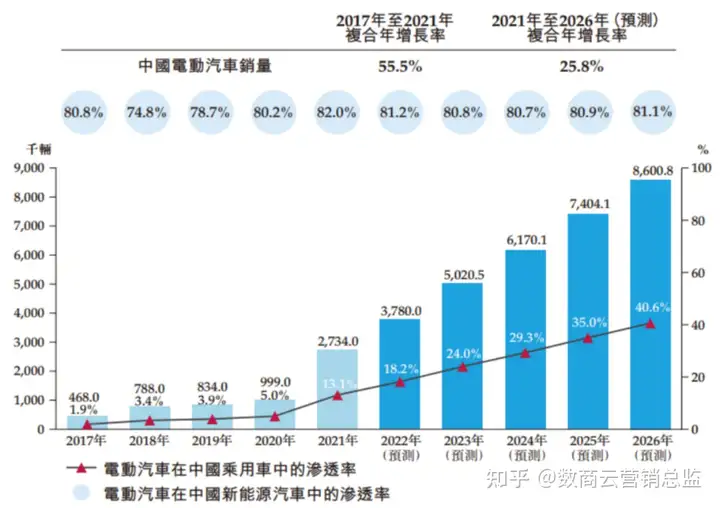
资料来源:弗若斯特沙利文,安信国际
三是纯电动汽车是我国新能源汽车的发展主力。
2019—2021年纯电动汽车销量占比连续攀升。《新能源汽车产业发展规划(2021—2035年)》提出力争经过15年的持续努力,纯电动汽车成为新销售车辆的主力。当前,纯电动汽车是我国新销售的新能源汽车主力。未来,纯电动汽车将成为销售汽车的主力。
四是中小城市与乡村地区未来可能会成为新的市场空间。
随着汽车产业电动化程度的加深,当前,新能源汽车渗透率较低的中心城市与乡村地区,将有可能会成为新能源汽车新的市场空间。2022年国家发展改革委等部门印发《促进绿色消费实施方案》提出:深入开展新能源汽车下乡活动,鼓励汽车企业研发推广适合农村居民出行需要、质优价廉、先进适用的新能源汽车,推动健全农村运维服务体系。新能源汽车下乡有可能成为未来新能源汽车产业发展的一个重要现象。
五是新能源汽车厂商的竞争可能会加剧。
当前,传统车企在新能源汽车领域呈现出较强的开拓能力,造车新势力作为新锐势力也表现出不俗的水平。新能源汽车产业快速发展的同时,也将可能伴随着竞争加剧,市场的集中度可能会进一步提升。
六是充换电基础设施的进一步发展。
随着新能源汽车保有量的进一步增长,将会给汽车的能源补给基础设施带来重大改变,对于充换电基础设施的建设提出更高的要求。这种要求既体现在充换电基础设施的数量要求,又体现更为先进的充换电技术创新和充换电技术标准的完善。
2023中国电动车充换电及轻型动力电池行业“鲁班奖”评选活动正式启动
国家能源局“电力调峰辅助服务”补贴项目
一、 联合成立协调机制
经研究,成立“电源行业碳达峰、碳中和推进联合工作办公室”(下简称:联合工作办公室),作为长期开展行业服务协调机构。机构设立在电源行业协会秘书处。
二、全面开展“电力调峰辅助服务”行动
结合国家相关政策,通过采集企业可调节负荷实时监测用电数据,结合辅助服务市场的价格预测和国网出清价格统计分析、总结辅助服务市场价格规律,以价格规律为指导用户负荷调节的基础,并结合实际运行情况、调整用户负荷,整合用户进行电网调峰,最终实现消纳电网剩余电量,保障电网安全稳定运行。
联合工作办公室现向全国社会及会员企事业单位征集申请参与“电力调峰”用户侧企业,将对电力用户发放《动力节能设备调研备案表》,对提出参与“电力调峰服务”并经过审核符合条件签署《电力调峰服务协议》的企业单位,授予“双碳经济建设示范企业”称号和牌匾,并在行业专项网站予以公示。由联合工作办公室委托的具有“国家能源局授权资质”的专业机构直接给予资金补贴。
三、参与“双碳经济建设示范企业”范围与条件
凡具有独立法人主体(或其授权),申请利用自身可调节负荷资源参与响应“电网调峰的辅助服务”的企事业单位,均可以申报“双碳经济建设示范企业”。
▼ 申报资质和提交资料
1. 申报企业具备独立法人主体的企事业单位均可提出申请。
2. 申报企业可调节负荷范围包括(不限于):工业生产用电、电采暖储暖、电储能、电动汽车充电等高耗能企事业单位。
3. 申报企业电能指标:变压器容量在1000KVA;年用电量在100万度左右。
4. 申报企业需提供三个月至一年的《电费缴纳通知单》,填写提交《动力节能设备调研备案表》。


评论
发表评论