Only entrepreneurs can solve China's "stuck neck" problem 刘忠范院士:只有通过企业家才能解决中国“卡脖子”问题
刘忠范院士:只有通过企业家才能解决中国“卡脖子”问题

Academician Liu Zhongfan: Only entrepreneurs can solve China's "stuck neck" problem
Stuck neck technology requires continuous investment and persistence
We often talk about neck-stuck technology, which is actually a hard technology. It requires decades of persistence and real investment. The deep-rooted root of most neck-stuck technologies is materials and equipment. my country's high-tech industry materials and equipment are all weak points. We are a country with a lot of materials, but not a country with materials. This is an obstacle that cannot be bypassed to solve the neck-stuck problem.
Stuck necks are made by grinding, which requires decades of hard work and continuous resource investment. If we don't change the behavior of eager for quick success, the practice of mass movement, and the traditional way of thinking of high quality and low price, there will continue to be bottleneck problems in the field of hard technology. The incomplete chain of technological innovation is actually the deep-seated cause of many bottlenecks, which is manifested as the phenomenon of "two skins" between technology and economy.
For example, the graphene industry is a hard technology industry, and its preparation determines the future. Without a real breakthrough in materials, it is hard to say that it will become an industry. Materials are the cornerstone of the graphene industry. Without a breakthrough in large-scale preparation technology, there will be no industry. Preparation technology is the bottleneck of the future graphene industry.
Only entrepreneurs can solve China's bottleneck problem, because in the end technology must be implemented through enterprises. Although I don’t run an enterprise myself, our team does. Enterprises are the main body of all basic research and technology research and development achievements, and they are also the only path. Only through the efforts of entrepreneurs can the bottleneck problem be truly resolved.
What is the best model for industry-university-research collaborative innovation? The current common practice is to put people with completely different stakeholders on one platform for collaborative innovation, which is similar to forcing multiple machines to work together, which is actually a huge challenge. The truly efficient model is still an enterprise as the main body of innovation. Internal R&D personnel, engineers and entrepreneurs work closely together, similar to the operation of a machine, so more attention should be paid to the strength of the enterprise.
Pay attention to entrepreneurs and develop hard technology
The development of the hard technology industry requires five forces: the development of the hard technology industry requires the power of "entrepreneurs" with high aspirations and courage; the power of "innovators" who create something out of nothing and lead the market; The power of "investors" with courage and insight; the power of "industrial ecology" with fine division of labor and fair competition.
Our country’s scientific and technological development achievements in the past 30 years have benefited from the country and society’s respect and investment in scientists. I think the competition of China’s high-tech industry in the next 30 years will depend on the innovative vitality of entrepreneurs and innovative entrepreneurs of small and medium-sized enterprises. Scientists create productivity indirectly, while entrepreneurs directly create productivity. We should treat entrepreneurs as much as we respect and value scientists.
Everyone knows that the National Science Conference in 1978 was regarded as the spring of science. I think now is another spring of science. The times have given us unprecedented opportunities, and we have ushered in another spring of China's scientific and technological undertakings and high-tech industries. . Innovation-driven development has become the main theme of the new era, which is the result of major changes unseen in a century. At the same time, innovation is also necessary to realize the great rejuvenation of the Chinese nation, and a country without innovation ability cannot truly rejuvenate. Let us also work together to seize such a rare opportunity of the times and strenuously move towards the future. Thanks!
Under the complex and ever-changing international situation, breaking through the "stuck neck" technology is still the current focus. In order to solve the technology and production restrictions brought about by trade control and other means, from the policy end to the enterprise end, we are trying our best to promote the development of high-tech. Judging from the results, many industries have adopted various measures to promote technological breakthroughs, and gradually make up for various key subdivisions that need to "make up for shortcomings", "forge long boards" and "fill in gaps". Then, in the face of the "stuck neck" problem, how should Chinese enterprises break through.
Why is China always stuck?
Before analyzing how Chinese companies can break through, let’s first analyze why China is always stuck.
I believe that the answer to this question for most people is: China started late and has a low starting point, so it has been desperately catching up.
In fact, this answer is not very rigorous. Compared with Europe and the United States, China's industrialization time is indeed later. But on another level, China has continued from ancient civilization to the present, and it has been thousands of years. Looking back on the past, it is easy to find that "stuck neck" has existed since ancient times, but it is expressed in different ways. Sometimes it's military, sometimes it's political, and sometimes it's economic.
The most encountered in China's history is military bottlenecks.
About 2,000 years ago, flexible cavalry replaced cumbersome chariots. The Central Empire south of the Great Wall began to face the threat of the horseback people in the north, and frequently encountered military bottlenecks. The Huns invented the stirrup (before industrial civilization, the stirrup was one of the epoch-making inventions that changed the world, and there may have been cloth stirrups before the iron stirrup), which was able to pinch the neck of the Han Empire before Emperor Wu of the Han Dynasty. Although Emperor Wu of the Han Dynasty won many wars with the two famous generals Wei Huo and defeated the Huns, he still could not eliminate the threat of the horseback nation. Later, Xianbei people, Rouran people, Khitan people, Jurchen people, and Mongols were able to use cavalry to attack the neck of the Kannon farming dynasty militarily at different times.
In the imperial era, the active horseback people on the grasslands north of the Great Wall had a population of about 2 million at best. In terms of comprehensive strength, regardless of the total population, total economic output, or the fertility of the land, the farming empire is far superior to the nomadic empire. But the farming empire has repeatedly been stuck. The reason-on the surface, the Yellow River Basin and the Yangtze River Basin, the core areas ruled by the agrarian empire, lacked horse farms; once the Hetao area was lost, they would be at a loss. But in essence, there is still insufficient technology and lack of scientific research perseverance.
China invented gunpowder a long time ago, and it had simple military applications in the Tang Dynasty; but its main function was the civilian application of setting off firecrackers, and it has never been able to produce a thermal weapon to restrain cavalry, which is simply incredible. Especially the Song Dynasty, because of the full development of the Yangtze River Basin and the development of maritime trade, it created a lot of wealth. The military pressure in the north is huge, but everyone is still obsessed with stereotyped liberal arts and scientific research. No one has devoted themselves to studying the usefulness of gunpowder. They are always helpless in the face of Khitan, Dangxiang, Jurchen, and Mongol cavalry.
Simply put, due to the lack of scientific research, the "stuck neck" crisis encountered by the farming dynasty has lasted for more than two thousand years and has not been resolved. Most of the 24 histories are about being stuck in the neck by stirrups.
To say this paragraph is not to belittle oneself, but to point out the lack of scientific research momentum. Today, the United States is launching a technological war. For China, the tool that gets stuck is just a stirrup turned into a chip; it needs to sum up experience and learn lessons from history.
In contrast, the Slavs were also stuck by cavalry equipped with stirrups; but after the 16th century, Tsarist Russian soldiers took a few simple broken guns, not only broke the neck of the stirrups, but also climbed over the Ural Mountains to occupy more than 10 million square kilometers. territory. The reason behind this is that the Slavs began to introduce a whole set of modern scientific systems. Especially in the field of mathematics, the Slavs have turned from a desert to a world-class mathematics power, and have trained many world-class mathematicians. Now China and the United States are trying to poach mathematicians from Russia, which is proof.
Since modern times, the history of the late Qing Dynasty and the Republic of China is the history of being stuck by the great powers from the military and political levels. It is humiliation and tears to say the least. After the Republic of China, the superpowers the United States and the Soviet Union also tried to pinch China's neck from the military and political levels, but they were all cracked. Today, no country can pinch China's neck from the military and political levels. This is a huge historical progress. However, since Trump took office, the game between China and the United States has expanded from a trade war to a technology war.
How Chinese companies are stuck in the neck of the United States
Now, let's try to understand how Chinese companies are stuck in the neck by the United States. To put it simply, a certain innovation in the products of Chinese companies is completely dependent on the technology of American companies, and there is no alternative. When the United States uses some means to prevent Chinese companies from using this technology, the products of Chinese companies will no longer be able to use it. reproduction.
The main bottleneck methods that can be used mainly include cutting off the supply chain, patent blockade, and ecosystem blockade.
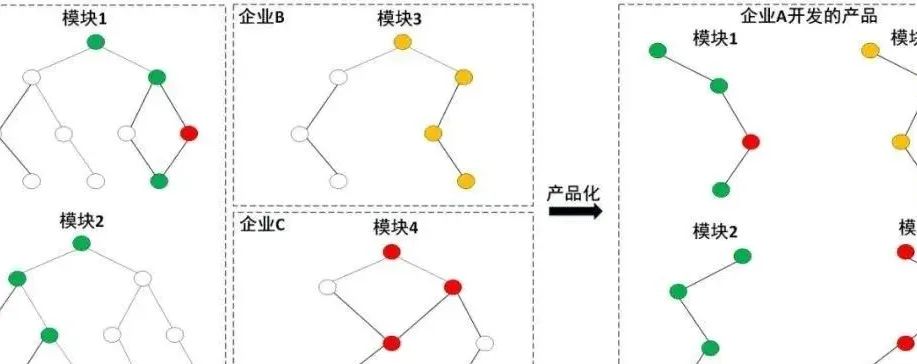
In order to make it easier for everyone to understand the above three methods, we formulate some assumptions based on the relationship between enterprise products and innovation: in most cases, innovation can produce patents, so we assume that each node has patent protection. The different colors in the nodes represent the ownership of the intellectual property rights of the innovation patents. We assume that green belongs to enterprise A, yellow represents enterprise B, red represents enterprise C, and enterprise C is a US enterprise.
(1) Cut off the supply chain
It is easy to understand that cutting off the supply chain means that you cannot buy the necessary modules. For example, the U.S. government puts company A on the entity list, which means that the sale of module 4 by company C to company A will be controlled by the U.S. government. Without module 4, if enterprise A cannot find an alternative technology for the time being, product development may stop.
(2) Patent blockade
A module is superimposed by many innovations, and peer companies may be innovating on a certain module, so a module is likely to contain patents from different companies. In the name of infringement, patents can claim that the products of infringing companies are prohibited from being sold in a certain area, so it may also become a means of getting stuck.
For example, if the patented technology of enterprise C exists in module 1 developed by enterprise A, enterprise C can apply to the court for compensation, or even ban the sale of related products in a certain area. Of course, this is also a double-edged sword. Assuming that enterprise C also uses module 1 in its own developed products, enterprise A can also sue him in turn.
Therefore, you can always see some scenes of "ants fighting elephants" in the patent battlefield. This is because on the one hand, small companies have no products, and large companies have no way to counteract them. On the other hand, large companies have high profits. Can get rich rewards.
(3) Ecosystem blockade
The essence of ecology is the result of the accumulation of habit by most people on a certain platform. For example, after decades of intensive cultivation of Microsoft's Windows operating system, application developers around the world have formed a habit of using it, and a large number of applications have also gathered on Windows. The operating system is installed on the hardware, the application is installed on the operating system, and the application gathers users. Users are accustomed to using the windows system, so hardware and applications become subordinate to the windows system.
Ecosystem blockade refers to restricting the upstream or downstream enterprises of the platform to achieve the bottleneck of the enterprise. Suppose that one day Microsoft announces that it is forbidden to install a certain application on Windows, basically declaring the demise of this application, or one day Microsoft announces that it will no longer be pre-installed on Lenovo notebooks, I believe it will have a great impact on Lenovo's sales. Because users may not give up the office office that has formed a habit for an application or a certain brand of notebook.
The Matthew effect is easily formed in the ecosystem. As time goes by, the number of users increases and user stickiness increases. The United States has a bunch of powerful ecosystems, especially operating systems. In addition to Microsoft's Windows operating system, there are also Google's Android operating system and Apple's IOS operating system.
Therefore, the blockade of the ecological circle is the most lethal way to get stuck, because this is a big move that really relies on time to accumulate power, rather than an instant "Eureka moment", which has gone beyond the simple innovation part.
An effective tool to solve the "stuck neck" problem
At present, the "stuck neck" problem faced by all walks of life in my country still needs to be solved. We all know that "key core technologies cannot be obtained, purchased or negotiated." Therefore, independent innovation and development of technologies is particularly important. From the policy side, we can see the country's emphasis on "stuck neck" technology from the layer-by-layer support policies.
In the 2022 government work report, the new term "specialized, special and new" appeared. The report proposes to focus on cultivating "specialized, refined and new" enterprises, and provide strong support in terms of capital, talents, and incubation platform construction. The field of "specialization, special innovation" has attracted attention because "specialization, special innovation" is an effective tool to solve the problem of "stuck neck" to a large extent. By focusing on subdivided fields and gaining competitive advantages in these fields, and even having the right to speak, it can effectively solve the "blocking points" of the industrial chain and establish China's technological advantages under the background of "stuck necks".
In terms of support measures, one of the core goals of the Beijing Stock Exchange, which was established in September 2021, is to become a "professional capital market development platform that effectively serves specialized and new SMEs."
In 2022, our country plans to cultivate about 3,000 national-level "specialized, special and new" small and medium-sized enterprises on the basis of the original, and drive the cultivation of provincial-level "specialized, special and new" small and medium-sized enterprises to increase from the current number of more than 40,000 to 50,000 around home.
In addition to all kinds of "specialized, special and new" small and medium-sized enterprises, various industries have introduced many policies to support the industry to break through the "stuck neck" technology.
Bai Chunli, president of the Chinese Academy of Sciences, previously stated that he would turn the "stuck" problem and the list of foreign export controls into his own task list. Concentrate expert elites to make major breakthroughs in key technical fields, thereby gradually breaking the technological blockade, which is conducive to grasping the initiative in technological and economic development.
In the field of integrated circuits, which is the most concerned by the public, the state has successively issued the "Guide Catalog for the First Batch of Application Demonstration of Key New Materials (2019 Edition)", "Notice of the State Council on Printing and Distributing Several Policies to Further Encourage the Development of the Software Industry and the Integrated Circuit Industry" and other support sex policy. At present, there are also many achievements: in February last year, the QUANTA team of the School of Computer Science, National University of Defense Technology, in conjunction with the Academy of Military Sciences, Sun Yat-sen University and other domestic and foreign units, developed a new programmable silicon-based optical quantum computing chip, which realized the quantum computing of various graph theory problems. Algorithm solving is expected to be applied in fields such as big data processing in the future.
In the field of optical machinery, the project team of the Shanghai Institute of Optics and Mechanics closed its research during the epidemic, and successfully used the large-aperture off-axis reflection exposure system to produce meter-level pulse compression gratings. The core is to use two large-aperture high-precision off-axis parabolic mirrors to form two beams. Parallel light constructs a uniform exposure light field in a large area. Among them, the pulse compression grating whose size needs to reach 1.6m×1.05m (two-way meter level, the diagonal line is close to 2 meters) is the key device of the system, and it is also one of the "stuck neck" technologies that still exist in the support device to ensure the realization of the international leading level . At present, existing grating preparation technologies at home and abroad, including mechanical scribing, fine-beam scanning splicing exposure, transmission static interference field exposure, etc., cannot achieve the ability to prepare such a bidirectional meter-scale large-scale grating. At the same time, after more than a year of hard work, the Shanghai Institute of Optics and Mechanics project team has invented an extremely narrow edge effect integrated flexible polishing technology and equipment, non-orthogonal magnetorheological polishing technology without track ripples, computer holographic phase plate detection, A series of innovative technologies such as low-stress support for large mirrors.
In addition, rare earth metal targets, as sputtering thin film materials, are widely used in many fields such as 5G communication, transportation, etc., but for a long time, this product and application have been blank in our country. The research and development personnel of Youyan Technology Group spent more than one year, experienced more than 30 tests, broke through casting, deformation, post-processing, binding and other technologies, and successfully developed multi-standard planar targets and large-size rotating targets. Reaching the 4N level, breaking the monopoly of foreign technology, and greatly improving the core competitiveness of my country's target materials.
How Chinese Enterprises Break Through Stuck Neck Technology
Now back to our original question, "How should Chinese companies break through the technology that is stuck in the United States." We have analyzed various methods of blocking the neck before, and of course we must target these methods in a targeted manner.
(1) Talent is the core
People are the origin of innovation and the source of innovation for the company. Businesses may go bankrupt over time, but people don't disappear because of business closures, but flow through the industry.
Innovators who have been in the industry for many years are valuable assets in this industry. Judging from the innovative formula, they have the most extensive and up-to-date information in the industry. At the same time, they are very familiar with the "Eureka moment" after years of innovation work. They are the "oil sellers" in this industry.
Therefore, enterprises should widely absorb "oil sellers" who know how to get stuck. By absorbing a large number of "oil sellers", enterprises can quickly accumulate useful information on the bottleneck module, and quickly solve the bottleneck method of "cutting off the supply chain".
With the accumulation of a lot of information, it is very likely that the "Eureka moment" came to one of this lucky team at a certain moment to help the company find another technical path to bypass this module patent, then solve The neck-blocking method of "patent blockade" was introduced.
Even, the enterprise may evolve the next-generation technology because of the "eureka moment" of a member of the team, and it is not difficult to create a short-term miracle of catching up.
(2) Focus on high-value patents
Each module has multiple technical paths, and patents only block one of them. Enterprises can choose alternative technological paths to bypass the patent blockade. However, the technical path that is finally used in the product is often the best way to weigh it. Therefore, changing the technology path is actually risky. In the face of "patent blockade", the safest way is to buy high-value patents on the technology path.
We must understand that the value of patents does not lie in quantity, but in quality. The ideal high-value patent is a patent that must be implemented in the module, which means that any company producing this module must implement it according to the patent, and it is difficult to find an alternative. Getting such a patent is worth thousands of unrelated patents. Therefore, companies only need to identify and obtain such a patent to counteract the bottleneck. After all, everyone has a patent weapon on the same module, which can form a subtle check and balance relationship.
(3) Start anew
The most difficult thing is the "blockade of the ecological circle". Since it has been abandoned by one circle, it can only start anew and build another circle by itself. As the saying goes, "Only magic can defeat magic", this big move accumulated by time can only be reduced by time.
But is there any way to speed up this time? At this time, it is necessary to open the classic "Selected Works of Mao Zedong" in which the weak overcome the strong. Chairman Mao said, "If there are many contradictions in any process, one of them must be the main one, playing a leading and decisive role, and the others are It is in a secondary and subordinate position. Therefore, when studying any process, if it is a complex process with more than two contradictions, it is necessary to find out its main contradiction with all efforts. Once this main contradiction is grasped, all problems will be solved easily. .”
That is to say, we need to find the main contradiction in the current ecosystem, and then solve this main contradiction in the new circle. For example, the Android system consists of open-source basic framework code and closed-source Google Mobile Application Services (GMS for short, including Google Mail, maps, wallets, etc.). Mobile phone manufacturers need to pay Android a license fee of US$0.75 per phone if they want to use GMS. Can they only use the basic framework code instead of GMS? Yes, but it’s not easy to use, because Google will gradually stop updating applications in the open source system , and only publish updated versions in GMS. It can be seen that the main contradiction of the Android system is the contradiction between mobile phone manufacturers and Google due to the tightly coupled system charges. Therefore, a new stove needs to focus on resolving this contradiction.
At the same time, we see that more and more Chinese people who have seen the world finally return to Chinese companies, and high-end talents are already in place; we also see that Chinese companies are starting to take the lead in new tracks such as 5G, new energy, and carbon neutrality. Patents are no longer a constraint; we have also seen that Chinese ecosystems such as Hongmeng and Euler have begun to challenge authority, and a single spark can start a prairie fire. come on! Chinese enterprises!
卡脖子技术需要持续投入与坚持
我们经常讲卡脖子技术,卡脖子技术其实都是硬科技,它需要数十年如一日的坚持和实实在在的投入,绝不是花拳绣腿,也不是一拥而上的群众运动所能及。
多数卡脖子技术的深层次根源是材料和装备,我国高科技产业材料和装备都是短板,我们是材料大国绝不是材料强国,这是解决卡脖子问题无法绕过的障碍。
卡脖子是靠磨出来的,需要数十年如一日地努力和持续的资源投入。如果我们不改变急功近利的行为、群众运动式的做法以及物美价廉的传统思维方式,在硬科技领域还会不断地产生卡脖子问题。技术创新链条不完整其实是产生诸多卡脖子深层次原因,表现为科技与经济“两张皮”的现象。
如石墨烯产业,就是一个硬科技产业,制备决定未来,没有材料上真正的突破,其很难说变成产业。材料是石墨烯产业的基石,没有规模化制备技术的突破,就不可能有产业,制备技术是未来石墨烯产业的卡脖子问题。
只有通过企业家才能解决中国卡脖子问题,因为最后技术必须通过企业才能实现落地。尽管我自己不做企业,但是我们的团队在做企业,企业是一切基础研究和技术研发成果转化落地的主体,而且也是唯一的路径,卡脖子问题只有通过企业家的努力才能真正解决。
产学研协同创新的最佳模式是什么?当前的普遍做法是,将利益主体完全不同的人放在一个平台上进行协同创新,类似于强迫多台机器协同运转,其实挑战巨大。真正高效的模式还是作为创新主体的企业,内部研发人员、工程师和企业家密切合作,类似于一台机器运转,因此应该更加重视企业的力量。
重视企业家,发展硬科技
发展硬科技产业需要五种力量:发展硬科技产业需要志存高远、勇往直前的“企业家”力量;无中生有、引领市场的“创新者”力量;追求卓越、醉心极致的“匠人”力量;慧眼识珠、有胆有识的“投资人”力量;分工精细、公平竞争的“产业生态”力量。
我们国家过去30年的科技发展成就,得益于国家和社会对科学家的尊重和投入,我认为中国未来30年高科技产业的竞争将依赖于企业家和中小企业创新创业人才的创新活力。科学家是间接创造生产力,企业家才是直接创造生产力,我们应该像尊重和重视科学家一样对待企业家。
大家都知道1978年全国科学大会被看作是科学的春天,我认为现在是科学的另一个春天,时代赋予了我们前所未有的机遇,我们又迎来了中国科技事业和高科技产业的另一个春天。创新驱动发展已经成为新时代的主旋律,这是百年未有之大变局所催生。同时创新也是实现中华民族伟大复兴所必需,没有创新能力的国家不可能真正地复兴。也让我们一道努力,抓住这样一个难得的时代机遇,踔厉奋发走向未来。谢谢!
在复杂多变的国际形势下,突破“卡脖子”技术仍是当下的重点。为解决贸易管制等手段带来的技术、生产限制,从政策端到企业端,都在极力推动高精尖技术的发展。从成果看,已有不少行业通过各项举措推动技术突破,逐步弥补各个需要“补短板”“锻长板”“填空白”的关键细分领域。那么,面对“卡脖子”难题,中国企业应该如何实现突围呢。
为何中国总被卡脖子?
分析中国企业该如何实现突围这个问题之前,我们先来分析一下,为何中国总被卡脖子?


评论
发表评论