Hong Kong's linked exchange rate system should be abolished香港的联系汇率制度该废除了

Hong Kong's linked exchange rate system should be abolished

The Yankees will definitely raise interest rates sharply in order to reap the harvest, because the window period for raising interest rates for the Yankees is running out, at most until June next year. But judging from the current situation, it might be possible to exit the rate hike cycle and enter the rate cut cycle in January next year. The reason is simple, the US economy cannot withstand such a violent rate hike. If the interest rate is raised too much, the fiscal revenue of the United States will not even pay the interest. The current employment data are all data created for raising interest rates, and cannot reflect the actual economic situation in the United States at all. However, if the United States wants to complete the harvest, it must create data and detonate the economies of non-US countries through violent interest rate hikes, and force these countries to seek help from the United States and its leading international financial organizations to sell their core high-quality assets. I have been emphasizing that the repatriation of US dollars is not the purpose, but the fundamental purpose is to re-emerge to acquire high-quality assets.

     Since Hong Kong implements a linked exchange rate system, superimposed on the recent situation in the Taiwan Strait and the new crown epidemic, if the United States continues to raise interest rates substantially, the continuous outflow of dollars will explode Hong Kong's stock market, foreign exchange market and bond market. Hong Kong's foreign exchange reserves cannot be stopped under the strangling of international capital. Therefore, I have been suggesting that Hong Kong should abolish the pegged exchange rate system of the US dollar in due course and instead anchor the RMB. If you don't rely on the future boss, you rely on a declining empire, and of course you will be led into the ditch by the declining empire. However, too many so-called economists in the mainland and Hong Kong are trained by the United States, and it is difficult to escape the economic trap laid by the United States. I recently heard that Buffett lost hundreds of billions, which is normal. Buffett was originally a bureau of Western capital, and he is not losing money at this time, how can he cut it? A lot of Buffett's funds come from foreign funds (many of which are sovereign funds). Isn't it good to lose money? There is no god in the world, and anyone who is too mythical, especially one that is too omnipotent and mythic, should be suspected. That Musk is also a big fool.

     Even if the U.S. dollar raises interest rates sharply, we will not raise interest rates casually. We have to operate counter-cyclically and prepare to replace the US dollar. More than 160 countries around the world stand behind us, and we also need to ensure their economic security. The set played by the United States is not very clever, but it is actually very easy to crack. No need for US dollars. It is a joke to denominate a lot of data in US dollars. Take Russia as an example. Before the war, the GDP was only a little in US dollars. Shortly after the war, it immediately dropped by 80% in terms of exchange rates. After the war, it has returned and its GDP has increased. This is not a nonsense thing. Therefore, we don't need to guide or explain our economy according to the economic theory of the United States. Hong Kong should take this opportunity to unshackle itself, why should it dance with the baton of the Yankees.

     In fact, up to now, the United States has nothing to do with us. Although we do have some gaps in cutting-edge technology, the problem is that these cutting-edge technologies have little impact on us, we don't use them, and our society still functions normally. The United States is now engaged in a financial war, and we feel that Hong Kong should stand on our side and abolish the pegged exchange rate system. Although the abolition of the linked exchange rate system may cause certain fluctuations, there will be no problem with the backing of a strong mainland. Hong Kong’s trade with the mainland can be done in renminbi, and Hong Kong’s non-US allies can use renminbi or U.S. dollars (the mainland’s U.S. dollar deficit is sufficient). Hong Kong will remain a global financial center in the future. The reason is very simple, our strength is enough to support. Most of the more than 200 countries or regions in the world will stand by our side. Don't be snobbish all the time. When developing countries account for the majority of the population, the financial scale is not expected to be small. Why do you have to hug the lap of a fallen empire?

     If more than 200 countries around the world, and more than 170 countries on our side, do not use the US dollar, what can the United States do? beat? We have most of the technologies these countries need, and what we don't have is actually dispensable. In terms of military strength, these more than 170 countries are more than enough to beat the United States and its so-called allies. What's so scary?

     It's time for Hong Kong to act on repeal.

  Should Hong Kong's currency system be "changed" or "unchanged"?

Will the linked exchange rate system, once regarded as the cornerstone of the Hong Kong dollar and financial stability, change? It is related to many market expectations.

Since 1983, the Hong Kong government has been implementing the pegged exchange rate system for the Hong Kong dollar, but today, with the "great changes unseen in a century", will all this be changed due to changes in the policy environment and related legal systems?

Going out of the period of "silver standard" and "linked to the British pound", the linked exchange rate system, which was born from the historical mirror of the "floating exchange rate" period and has been in operation for 37 years, has experienced the "stock market crash" in 1987 and the European exchange rate mechanism storm in 1992 , the 1994/95 Mexican currency crisis, and the Asian financial crisis and many other challenges and tests, it seems that it is still rock solid...

Now, what are the trade-offs in this monetary system that has both pros and cons? Its "benefits" lie in reducing uncertainty and exchange rate fluctuations caused by speculative capital; its "disadvantages" are credit pressure and the lack of ability to use monetary policy to adjust the economy.

The adoption of the pegged exchange rate system between the Hong Kong dollar and the U.S. dollar is the choice of the Hong Kong government, not an external arrangement, let alone its consent and approval. Similar international cities such as Singapore, Luxembourg, and Dubai provide relevant reference value.

So, should Hong Kong's currency system be "changed" or "unchanged"?

one

This has to start with the basic content and essence of the linked exchange rate system between the Hong Kong dollar and the U.S. dollar.

In 1983, Hong Kong began to implement the linked exchange rate system between the Hong Kong dollar and the US dollar (referred to as the "linked exchange rate system"). According to the law, starting from October 17, 1983, all note-issuing banks authorized by the Hong Kong Monetary Authority (hereinafter referred to as the "HKMA") will exchange 1 US dollar for 7.8 Hong Kong dollars, and report to the "Exchange Fund" managed by the HKMA in advance. Additional Hong Kong dollar banknotes can only be issued after paying US dollars in exchange for an equivalent Hong Kong dollar "certificate of indebtedness", and the paid US dollars become the value reserve of Hong Kong dollar banknotes. When the note-issuing bank withdraws and destroys the Hong Kong dollar banknotes, the HKMA will redeem the certificate of indebtedness with US dollars according to the ratio of 1:7.8 and supervise the destruction of the corresponding Hong Kong dollar banknotes by the bank, and the bank will withdraw the corresponding US dollars from the Exchange Fund.

After the implementation of the linked exchange rate system, maintaining a stable exchange rate between the Hong Kong dollar and the U.S. dollar has become the sole goal of Hong Kong's monetary policy. The inflow or outflow of funds can only be allowed to affect the interest rate rather than the exchange rate that exceeds the allowable range (based on 7.8, with a fluctuation range of 0.05 basis points for each, that is, the allowable space for the actual exchange rate of the Hong Kong dollar to the US dollar is 7.75 to 7.85). In order to reduce excessive fluctuations in interest rates, the Monetary Authority adjusts interest rates mainly through the expansion or contraction of the discount window. In order to effectively cope with the impact of international capital on the Hong Kong dollar exchange rate, the Monetary Authority launched a linked exchange rate system protection measure in 2005: the exchange rate of 1 US dollar to 7.75 Hong Kong dollars was determined as the strong-side convertibility guarantee exchange rate, that is, the Hong Kong Monetary Authority guarantees that when the Hong Kong dollar strengthens to 7.75 against the US dollar According to this exchange rate, US dollars are sold for Hong Kong dollars; 7.85 Hong Kong dollars for 1 US dollar is determined as the exchange rate of the weak-side convertibility guarantee.

It should be noted that the pegged exchange rate system between the Hong Kong dollar and the U.S. dollar, the Hong Kong dollar should be backed by the U.S. dollar, but in fact it is mainly Hong Kong dollar cash that is backed by U.S. dollar reserves. In today's society, cash is not the whole of the total currency. With the bank's "account settlement" increasingly replacing "cash settlement", and with the continuous development of social mobile payment, the proportion of cash in the total currency of the whole society It is getting lower and lower (currently countries and regions with relatively developed market economies are generally less than 4%). Most of the money is released through bank loans or bond purchases. On the basis of agreeing to repay principal and interest in full amount in a timely manner, the bank can maintain sufficient liquidity to ensure depositors' external payment needs, but it is not based on ensuring that these currencies can be fully converted into foreign exchange. Considering the existence of this situation, in essence, the larger the monetary aggregate, the lower the proportion of cash, and the greater the challenges and pressures that the Hong Kong Monetary Authority will face in maintaining the peg between the Hong Kong dollar and the U.S. dollar.

two

Therefore, what has to be mentioned is the relationship between the Hong Kong dollar and the U.S. dollar linked exchange rate system.

The implementation of the pegged exchange rate system between the Hong Kong dollar and the U.S. dollar means that Hong Kong has given up its independent monetary policy and is more subject to the monetary policy of the U.S. dollar system. It is difficult to give full play to the macro-regulatory role of monetary policy in economic and social development and stability. However, considering that Hong Kong mainly develops a highly open export-oriented economy, focuses on the development of commodity re-export and service trade, and is committed to building an international financial center, it needs to better integrate into the international legal system and monetary and financial systems. Among them, the establishment of a solid linked exchange rate system with the U.S. dollar as the international central currency can greatly enhance the international recognition and circulation of the Hong Kong dollar. Therefore, the linked exchange rate system has played an important role in the stability and development of Hong Kong. A certain period before and after may be more important.

Of course, since the Hong Kong economy is different from the US economy after all, the factors that affect it are also very different. When there is a significant deviation between the economic development and financial stability of the two sides, and when there is a significant deviation in the international community's demand for the two currencies, it is necessary to maintain This linked exchange rate system may face great challenges, requiring the Hong Kong Monetary Authority and the government to have strong US dollar reserves, credit endorsement, and the ability to monitor and manage the currency market and the entire financial market.

According to Chen Maobo, Hong Kong’s financial secretary, Hong Kong currently has about 440 billion US dollars of foreign exchange reserves, which is more than twice the amount of Hong Kong’s currency in circulation (actually referring to cash) equivalent to US dollars, which better supports the exchange rate system in which the Hong Kong dollar is pegged to the US dollar . However, the foreign exchange reserves of 440 billion US dollars are only about 25% of the total currency amount of more than 14 trillion Hong Kong dollars (about 1.8 trillion US dollars). If there is a large-scale demand for Hong Kong dollars to be exchanged for US dollars, the Hong Kong government and The Monetary Authority may still face enormous pressure to make arrangements for US dollar financing with the central bank of mainland China and other central banks in advance.

But it needs to be made clear that adopting the pegged exchange rate system between the Hong Kong dollar and the U.S. dollar is the choice of the Hong Kong government itself, not an external arrangement, and their consent and approval are not required. In fact, the implementation of this pegged exchange rate system pegged to the U.S. dollar is conducive to enhancing the international influence of the U.S. dollar and its sovereign state, and is not harmful to the sovereign state. Of course, if the dollar-sovereign countries can support it (such as not restricting Hong Kong's international trade and financial exchanges, making commitments to support currency swaps, etc.), it will be more conducive to the implementation of this pegged exchange rate system. On the contrary, if a country or region is included in the sanction list by a dollar-sovereign country, and its dollar receipts and payments are controlled by that country, this pegged exchange rate system pegged to the dollar may lose its basis for survival.

Therefore, the U.S. dollar sovereign state may not directly seek to cut off the peg exchange rate system between the Hong Kong dollar and the U.S. dollar. The payment and clearing system (such as SWIFT) controls the receipt and payment of US dollars by sanctioned objects, and even more generally controls the flow of US dollars into and out of Hong Kong, correspondingly weakening the basis of the Hong Kong dollar-US dollar pegged exchange rate system.

However, considering that Hong Kong has become an important international financial center, Hong Kong dollar note-issuing banks include HSBC, Standard Chartered Bank and Bank of China, multinational companies and financial institutions of US dollar sovereign countries and even the government of the country have large investments and interests in Hong Kong. If the US dollar Sovereign countries rashly implement a large-scale and vigorous control of the flow of US dollars into and out of Hong Kong, which will not only have a major impact on Hong Kong, but will also have a major impact on the US-dollar sovereign itself, many countries and the global financial market, including a severe setback in national relations and even global financial markets. Asset prices; if so, I believe that Hong Kong will receive full support from the central bank and the government.

Therefore, unless special events occur, US dollar sovereign countries may not easily take strong measures to directly impact the peg exchange rate system between the Hong Kong dollar and the US dollar. However, it is still necessary to make worst-case preparations for the impact of possible sanctions on the dollar sovereign states.

three

In fact, the linked exchange rate system is not the only option for Hong Kong.

For Hong Kong, adopting the pegged exchange rate system between the Hong Kong dollar and the U.S. dollar has advantages and disadvantages, and requires very important conditions, including a high degree of openness and active integration into the international legal system and monetary and financial system dominated by U.S. dollar sovereign states. However, with the formal promulgation and implementation of relevant new laws in Hong Kong, the attitudes and policies of European and American countries towards Hong Kong are undergoing profound changes. Facing the increasingly obvious "great changes unseen in a century" in today's world, Hong Kong maintains a fixed peg between the Hong Kong dollar and the US dollar What kind of challenges the exchange rate system will face, what changes may occur in its pros and cons, and whether fundamental adjustments (changes to the linked exchange rate system) are necessary have become unavoidable major issues that really need careful consideration.

In fact, a fixed peg to the US dollar is not Hong Kong's only option.

For example, Singapore, Luxembourg, Dubai and other highly open and international city-states or governments similar to Hong Kong did not choose a pegged exchange rate system fixedly linked to international currencies such as the US dollar or the euro, but implemented an independent monetary and policy system. There is more space for coordinated operation in interest rate and exchange rate management. Singapore, which is also in Asia, has not brought serious negative impacts due to the implementation of an independent monetary policy. On the contrary, it has stronger flexibility in international competition and currency management. Its advantages compared with the Hong Kong dollar are gradually increasing. Not weakened.

What needs to be seen here is that the practice of pegging to gold or a certain foreign currency itself is not in line with the direction of the development of national credit currency. The promise of "1 ounce of gold equals $35" was also forced to give up by 1971.

Therefore, no matter from the perspective of maintaining the stability of Hong Kong's currency and financial system in response to profound changes in the international situation, or from the practical effects of independent monetary policies in countries such as Singapore, it may be necessary for Hong Kong to seriously consider the future of the Hong Kong dollar-US dollar peg exchange rate system—whether it is necessary to Transform into an independent currency system as soon as possible? And come up with the necessary implementation plan.

From the point of view of specific operation, it may not be a difficult change to adjust the pegged exchange rate system between the Hong Kong dollar and the U.S. dollar. It seems that the Hong Kong Monetary Authority can assume the responsibilities of the Central Bank of Hong Kong, and by changing the creditor-debt relationship with the note-issuing bank, the "foreign exchange fund" deposited by it can be converted into foreign exchange reserves directly owned by the HKMA (relative to the total amount of money). , Hong Kong's foreign exchange reserves are relatively large). Of course, to adjust the pegged exchange rate system with the U.S. dollar to an independent monetary and policy system, the Hong Kong Monetary Authority must, like the Singapore Monetary Authority, effectively strengthen the ability to monitor currency exchange and financial markets, as well as control interest rates and exchange rates.

The confidence of forty-nine shots

On May 4, the Hong Kong Monetary Authority took on a sale order of 4.671 billion Hong Kong dollars. This is the 49th time that the Hong Kong Monetary Authority has purchased Hong Kong dollars since May 2022. It has bought more than 290 billion Hong Kong dollars in total, stabilizing the exchange rate of the Hong Kong dollar against the US dollar at 7.75 to The range of 7.85 has effectively maintained the stability of Hong Kong's linked exchange rate system.

Hong Kong is a highly open economy with no foreign exchange controls, so it is very important to maintain a stable exchange rate. Since 1983, Hong Kong has implemented a linked exchange rate system, that is, the note-issuing banks have all exchanged 1 US dollar for 7.8 Hong Kong dollars, paid US dollars to the Exchange Fund in advance, and exchanged the equivalent Hong Kong dollar "indebtedness certificate" before issuing additional Hong Kong dollar cash. At the same time, the government promises that after the Hong Kong dollar cash is returned from circulation, the note-issuing bank can also exchange it back to the US dollar at this rate. After Hong Kong returned to the motherland, the Basic Law authorized the government of the Hong Kong Special Administrative Region to formulate its own monetary and financial policies, guarantee the freedom of operation of financial enterprises and financial markets, and conduct management and supervision in accordance with the law. Article 112 of the Basic Law clearly stipulates that Hong Kong does not implement foreign exchange control policies and that funds flow freely.
The 49 shots are a firm implementation of the design of the linked exchange rate system. Under the linked exchange rate system, if the market demand for Hong Kong dollars increases and the Hong Kong dollar exchange rate rises to the strong-side convertibility guarantee level of 7.75 Hong Kong dollars to 1 U.S. dollar, the Hong Kong Monetary Authority will buy U.S. dollars and sell Hong Kong dollars at the request of banks, so that the aggregate balance of the banking system will increase and the Hong Kong dollar interest rate will increase. If the market demand for Hong Kong dollars decreases and the Hong Kong dollar exchange rate falls to the weak-side convertibility assurance level of 7.85 Hong Kong dollars to 1 US dollar, the HKMA will buy Hong Kong dollars and sell US dollars at the request of banks, reducing the aggregate balance of the banking system and pushing up Hong Kong dollar interest rates. The purpose of both operations is to stabilize the exchange rate of the Hong Kong dollar against the US dollar within the range of 7.75 to 7.85.
Under the linked exchange rate system, the Hong Kong dollar interest rate is generally close to the U.S. dollar interest level, but it will also be affected by the supply and demand of Hong Kong dollar funds in the local market. In reality, it will not follow the U.S. dollar interest rate at the same rate at any time, which creates arbitrage space. The United States will enter a rate hike cycle in March 2022. Since the interest rate of the US dollar is higher than that of the Hong Kong dollar, market carry trades are induced, that is, Hong Kong dollars are lent at a lower interest rate, and then exchanged for US dollars with a higher interest rate to earn a spread. Arbitrage activities caused the exchange rate of the Hong Kong dollar to repeatedly touch the level of the weak-side convertibility guarantee, and the Hong Kong Monetary Authority subsequently bought Hong Kong dollars.
The 49 shots are a demonstration of the strong resilience of Hong Kong's financial and banking system. As of the end of April this year, Hong Kong's foreign exchange reserve assets stood at US$427.4 billion, equivalent to more than five times the currency in circulation in Hong Kong, and equivalent to 40% of the Hong Kong dollar's broad money supply. In addition, the exchange fund bills and bonds held by banks exceed HK$1.1 trillion. When necessary, these exchange fund bills and bonds can be used as collateral at any time to obtain Hong Kong dollar liquidity through the HKMA.
Every time the Hong Kong Monetary Authority buys Hong Kong dollars, it means that the same amount of funds will flow out of the Hong Kong dollar system, which is reflected in the reduction of the aggregate balance of the Hong Kong banking system. As of May 5, the aggregate balance of the Hong Kong banking system fell to HK$44.527 billion, the lowest since November 2008. However, the outflow of funds from the Hong Kong dollar system does not mean the outflow of Hong Kong. At present, the total deposits of the Hong Kong banking system remain stable, and the overall deposits have increased by about 1.4% from the end of April last year to the end of March this year.
The 49 shots are a manifestation of Hong Kong's unique advantages of "relying on the motherland and connecting with the world". Short-term capital can arbitrage from the temporary interest rate difference, while long-term capital pays more attention to economic fundamentals. For international investors, the sound economic development of Hong Kong and the Mainland is the biggest bonus. When the Asian financial crisis occurred in 1997 and the international financial crisis occurred in 2008, the mainland's determination to firmly support Hong Kong in maintaining the stability of the linked exchange rate impressed the world. There is a strong motherland behind it, which dispels many attempts of speculative capital to stir up trouble. No matter how many times the exchange rate of the Hong Kong dollar touches the convertibility guarantee, the financial regulatory authorities will step into the market as many times as possible. No one will have the illusion of taking the opportunity to "break through" Hong Kong's financial system.
On May 5, the International Monetary Fund stated that the linked exchange rate system is still the most appropriate arrangement for maintaining Hong Kong's macroeconomic and financial stability. After going through ups and downs, Hong Kong's linked exchange rate system remains sound, and Hong Kong's long-term prosperity and stability remain unchanged.
1 Background of the Linked Exchange Rate System
1.1 Establishment of the Linked Exchange Rate System in Hong Kong
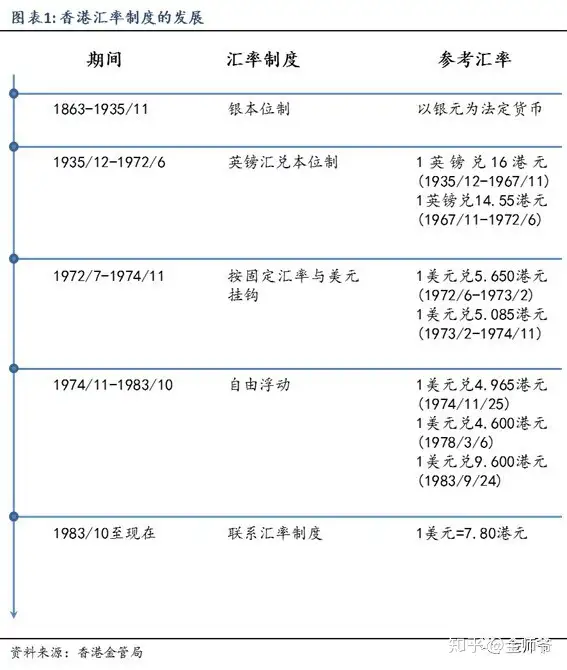
In 1863, the Hong Kong government announced that the silver dollar, the international currency at that time, was the legal tender of Hong Kong, and began to issue Hong Kong's own silver dollar in 1866. The 1935 silver crisis caused Hong Kong to abandon the silver standard and peg the Hong Kong dollar to the British pound at an exchange rate of HK$16 to £1, and the Currency Ordinance required banks to surrender all silver backing banknotes to the Exchange Fund in exchange for certificates of indebtedness ( One of the base currencies), the Exchange Fund invests the silver in sterling assets, and Hong Kong begins to implement the currency board system (Currency Board Arrangement, also known as the currency board system, the author's note: Britain has implemented this exchange rate system on a large scale in its colonies ). In June 1972, after the collapse of the Bretton Woods system, the United Kingdom decided to let the pound float freely. After that, the Hong Kong dollar was pegged to the U.S. dollar for a time, initially at 5.65 Hong Kong dollars to 1 U.S. dollar, and then changed to 5.085 Hong Kong dollars to 1 U.S. dollar in February 1973. In November 1974, due to the weakening of the US dollar, the Hong Kong dollar was changed to a free float.
Although the floating exchange rate system operated quite smoothly after its implementation, the situation thereafter was not ideal. Because Hong Kong's monetary policy framework was not perfect at that time, Hong Kong's economy fell into a period of turmoil. In 1975, the GDP growth rate was negative 0.3%, but it rose to 16.2% in 1976, and the inflation level rose sharply from 2.7% in 1975 to 1980. 15.5%. Speculative sniping activities and the intensified crisis of confidence in Hong Kong's prospects further worsened the depreciation of the Hong Kong dollar. In September 1983, the exchange rate of the Hong Kong dollar depreciated by 13% in two days. 9.60 Hong Kong dollars to 1 U.S. dollar in 2019.
In the face of the currency crisis, in order to dispel market doubts about the stability of related banks, the Hong Kong government announced a new policy on October 15, 1983 to stabilize the exchange rate of the Hong Kong dollar. This arrangement became the basis of Hong Kong's current peg.
1.2 International Currency Board System
The IMF currently adopts the classification of the exchange rate system updated in 2009. The main exchange rate systems are hard-pegged exchange rate system, soft-pegged exchange rate system and floating exchange rate system. kind of.
According to the IMF's latest "Exchange Arrangements and Exchange Restrictions 2018 Annual Report", there are currently 11 countries and regions that still adopt the currency board system, including Hong Kong, China, Djibouti, Bulgaria, Brunei, Bosnia and Herzegovina, and the Eastern Caribbean Currency Union (6 indivual). In terms of quantity, there are 17 fewer than in 1960. In terms of economic scale, these are small economies, and the combined GDP of the other 10 countries and regions is less than one-third of that of Hong Kong.
2 Contents of the Linked Exchange Rate System
2.1 Foreign exchange reserves
According to the definition of the Hong Kong Monetary Authority, the linked exchange rate system in Hong Kong belongs to the currency board system. Under this system, both the flow and stock of base money need to be fully supported by foreign exchange reserves. That is, any change in the base currency must be fully matched by a corresponding change in foreign exchange reserves calculated at a fixed exchange rate. This requires that Hong Kong's foreign exchange reserves must not be less than the base currency. Under several other exchange rate regimes, major central banks can issue currency by buying assets such as treasury bonds. Mainland China, which adopts a soft-pegged exchange rate system, and Britain and the United States, which adopt a floating exchange rate system, have less foreign exchange reserves than the base currency. Especially in the United States, since the US dollar is the most popular reserve currency, its foreign exchange reserves are almost zero, which greatly improves the independence of its monetary policy.
2.2 Exchange scope
In addition to the fixed exchange rate of 1 U.S. dollar to 7.8 Hong Kong dollars when issuing the base currency, the Monetary Authority also limited the exchange range by 500 basis points around 7.8 Hong Kong dollars. In 2005, the Hong Kong Monetary Authority launched a strong-side convertibility guarantee, promising to buy U.S. dollars from licensed banks and sell Hong Kong dollars at the exchange rate of 7.75 Hong Kong dollars to 1 U.S. dollar, and announced that the exchange rate level of the weak-side convertibility guarantee formulated in 1998 Adjusted from HK$7.80 to HK$7.85, selling USD and buying HKD when this level is reached. As a result, the Hong Kong Monetary Authority restricted the exchange rate within the range of 7.75-7.85 to maintain the relative stability of the Hong Kong dollar.
2.3 Interest Rate Adjustment
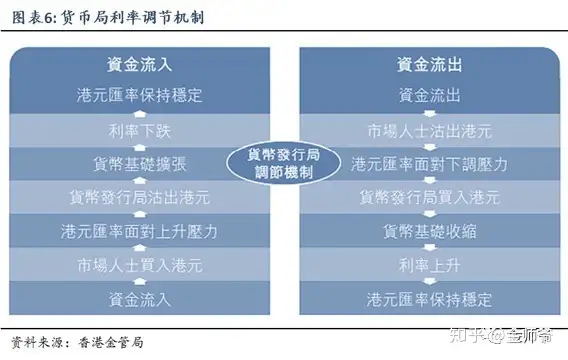
Under the linked exchange rate, capital flows cause changes in interest rates, while the exchange rate remains stable. When capital flows in, market participants buy Hong Kong dollars from banks, and banks sell U.S. dollars to the Monetary Authority in exchange for Hong Kong dollars. The base currency increases, which reduces the interest rate in Hong Kong, reduces the attractiveness of Hong Kong dollars, and automatically offsets the impact of capital inflows, and vice versa. It can be described as an automatic adjustment mechanism.
To reduce excessive volatility in interest rates, the HKMA will provide liquidity through the discount window. Its current base rate is determined by taking the lower limit of the U.S. federal funds rate target range plus 50 basis points, or the average of the five-day moving average of the overnight and one-month Hong Kong Interbank Offered Rate (HIBOR), whichever is higher .
3 Theoretical Basis of Linked Exchange Rate System
3.1 The Trilemma
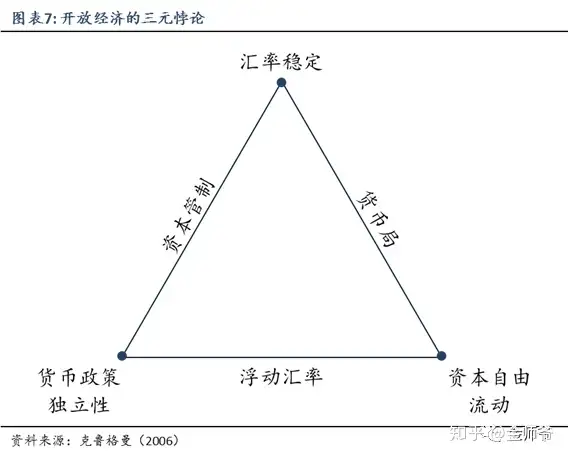
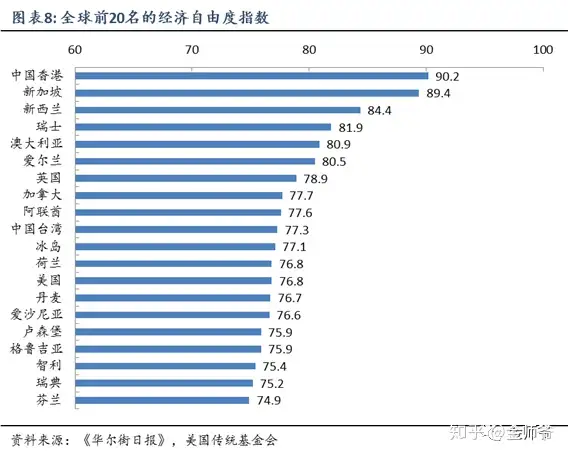
The "trilemma" states that in an open economy, it is impossible for a country or an economy to achieve three goals at the same time—independence of monetary policy, exchange rate stability, and free capital flow—only two goals can be achieved at the same time. Hong Kong is an international financial center. Its economic freedom index has ranked first in the world for 25 consecutive years, and international capital can flow freely. Policy makers, then, are left with a choice between exchange rate stability and monetary policy independence. The Hong Kong Monetary Authority pointed out that Hong Kong is a highly outward-looking and open economy. The total value of trade in goods and services is equivalent to three times the GDP. Therefore, it is very important to maintain the stability of the Hong Kong dollar exchange rate. It is also mentioned in the previous article that before it chose the linked exchange rate system, the Hong Kong dollar faced greater pressure to depreciate. Since it chose a stable exchange rate, it also gave up the independence of monetary policy at the same time. A rigid exchange rate system like this would deprive the economy of the flexibility it needs, especially in the face of a financial crisis when the central bank must act as the lender of last resort (Krugman, 2006).
3.2 Graphical Analysis of Monetary Policy
3.2.1 Responding to changes in US interest rates
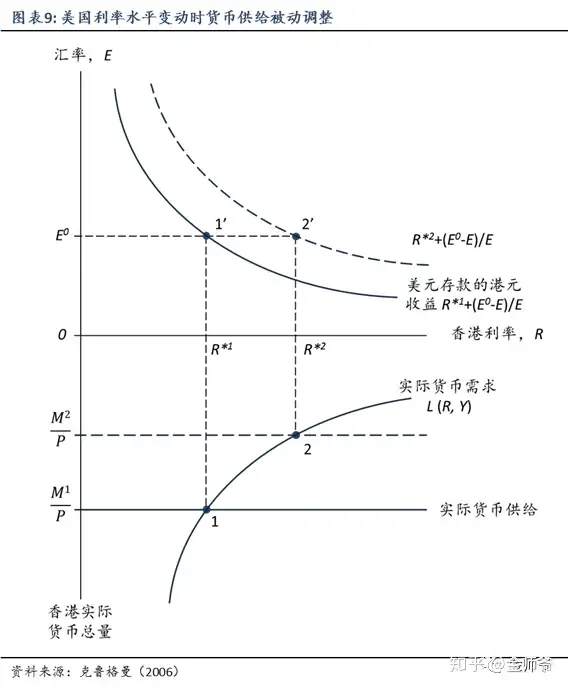
The "trilemma" pointed out that under the framework of the currency board system, the HKMA has no monetary policy independence. In this case, in order to keep the exchange rate E0 (calculated by the direct quotation method) unchanged, the interest rate of the Hong Kong dollar will follow the interest rate of the pegged US dollar. When the U.S. interest rate level rises to R*2, the Hong Kong dollar yield on U.S. dollar deposits rises accordingly, and the curve at the top of Chart 9 shifts to the right by R*2-R*1. At this time, however, Hong Kong's interest rate remains at R*1, which is lower than the expected return on new dollar assets. This difference will cause excess demand for US dollar assets in the foreign exchange market. In order to keep the exchange rate at E0, the HKMA must sell foreign exchange reserves to shrink the supply of Hong Kong dollars. Once the money supply falls to M2, the money market reaches equilibrium, the foreign exchange market clears (point 2), and the interest rate is R*2. In addition, from the Hong Kong dollar income formula of US dollar deposits, changes in the expected exchange rate E0 will have a similar effect. When the market shows that Hong Kong may not be able to maintain a fixed exchange rate, the Hong Kong dollar depreciation expectation (the US dollar appreciation expectation) will also make the upper curve right. However, the HKMA can only take measures to shrink the money supply.
3.2.2 Responding to changes in the national income level of the region
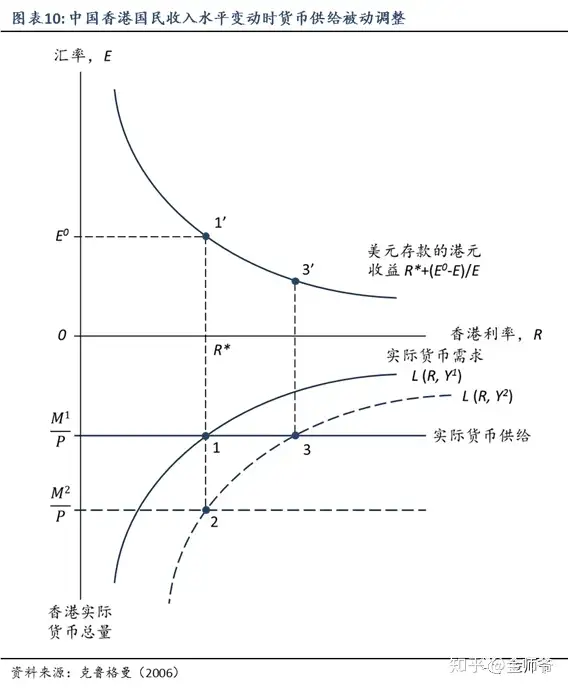
Internally, the HKMA is also unable to adopt a monetary policy that is oriented towards the goals of the region. As shown in Figure 10, under the LERS, the exchange rate is fixed at E0, and the Hong Kong dollar interest rate is equal to the U.S. dollar interest rate R*. When Hong Kong's national income level Y1 increases to Y2, real money demand increases accordingly. If the HKMA does not act, then the money market will reach a new equilibrium at point 3. Since the interest rate at point 3 is higher than R*, the Hong Kong dollar exchange rate has an appreciation tendency from point 1' to point 3'. Under the Linked Exchange Rate System, the Monetary Authority will not allow the Hong Kong dollar to appreciate, but will passively buy U.S. dollar assets and put them in Hong Kong dollars, increasing the money supply. As a result, at the new equilibrium point of the money market (point 2), the domestic interest rate is once again equal to R*, thereby maintaining the stability of the exchange rate. However, a failure to tighten monetary policy while the economy continues to grow can lead to inflation.
4 Challenges of the Linked Exchange Rate System
4.1 No independent monetary policy
The above analysis from a theoretical point of view makes it difficult for the Monetary Authority to do anything in response to changes in the US interest rate level and the national income level of the region under the linked exchange rate system. The result is that it cannot independently formulate a reasonable monetary policy according to the economic development of the region, but is restricted by the economic environment of the United States, so that the monetary policy of the United States is transmitted to Hong Kong. The following will explain the problems existing in the linked exchange rate from the four perspectives of interest rate adjustment, foreign exchange intervention, counter-cyclical adjustment and economic cycle.
4.1.1 Passively adjust the benchmark interest rate
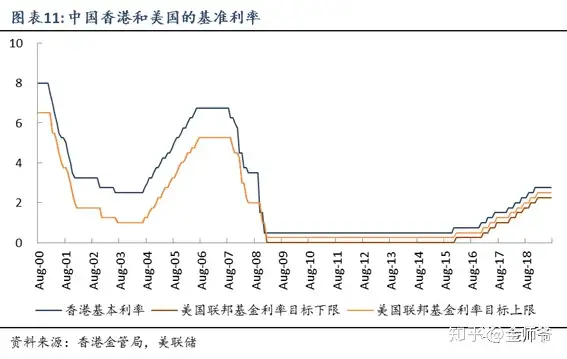
From the analysis in Chart 11, we can see that when the level of interest rates in the United States changes, Hong Kong needs to take corresponding actions to adjust interest rates in the same direction as the United States. The current Hong Kong discount window base rate is determined by taking the lower limit of the target range of the US federal funds rate plus 50 basis points, or the average of the 5-day moving average of the overnight and one-month Hong Kong interbank offered rate, whichever is higher. Judging from its trend, it basically remains consistent with the target of the US federal funds rate, but is slightly higher in most cases.
Whenever the Federal Reserve changes the benchmark interest rate, in addition to making corresponding adjustments immediately, the HKMA’s president will also give a speech explaining the reasons for the Fed’s change of the benchmark interest rate, Hong Kong’s current interest rate level and its impact on Hong Kong’s economy. This shows that Hong Kong's monetary policy is very dependent on the United States and has no independence.
4.1.2 Passive intervention in the foreign exchange market
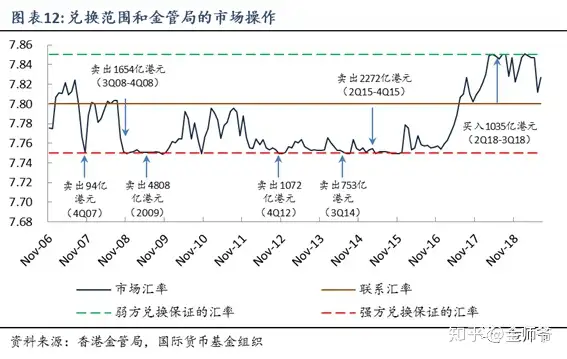
As mentioned above, the Monetary Authority limits the exchange rate within the range of 7.75-7.85. When the exchange rate reaches the convertibility guarantee level, the Monetary Authority must passively intervene in the foreign exchange market to change the supply level of Hong Kong dollars and limit the large fluctuations in the exchange rate. According to the IMF, from 2007 to 2018, the Hong Kong dollar exchange rate approached the strong-side convertibility guarantee more frequently. Therefore, the Hong Kong Monetary Authority has repeatedly adopted market operations of buying U.S. dollars and selling Hong Kong dollars to prevent excessive appreciation of the Hong Kong dollar. It can be seen that as long as the market exchange rate deviates from the target fixed exchange rate, the HKMA can only passively intervene in the foreign exchange market to adjust the supply of domestic and foreign currencies.
4.1.3 Weakening the ability of counter-cyclical regulation
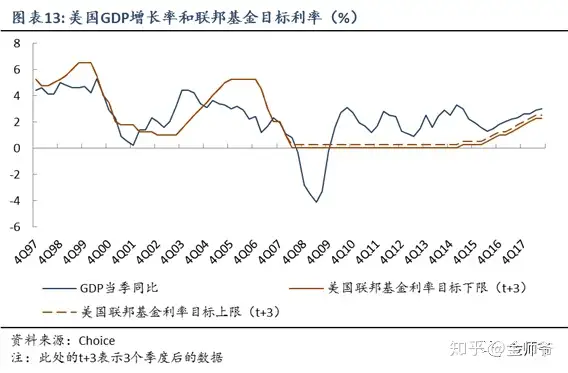
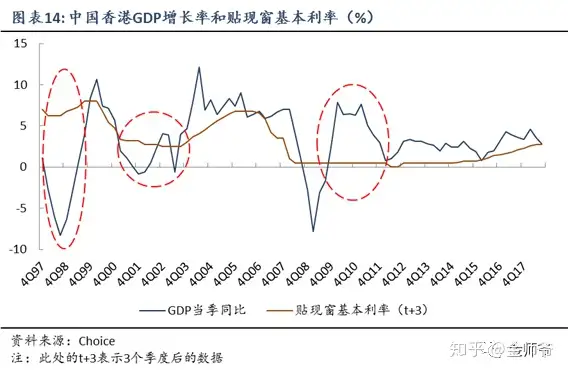
As mentioned above, in order to maintain the stability of the exchange rate, the Monetary Authority must keep the interest rate level consistent with that of the United States, so it cannot adopt a reasonable monetary policy according to the national income level of the region. Considering that there is a lag period of about 3 quarters in the counter-cyclical monetary policy, we adjust the chart accordingly to compare the relationship between the GDP growth rate and the benchmark interest rate. Figure 13 shows that the Fed funds target rate and the GDP growth rate in the United States are quite consistent. It can be seen that the Federal Reserve can independently adopt monetary policy according to economic growth. However, as shown in Figure 14, Hong Kong's discount window base rate and GDP growth rate diverge in some periods of time. From the fourth quarter of 1997 to the second quarter of 1999, due to the impact of the Asian financial crisis, Hong Kong's GDP growth rate declined, and there were even signs of economic recession, but the basic interest rate of the discount window remained high. The impact of the "9.11" incident in 2001 on Hong Kong's economy was even greater than that of the United States, and the monetary policy at this time was also difficult to stimulate the economy. After the global financial crisis in 2008, Hong Kong's economy recovered rapidly. In 2010, the GDP growth rate was greater than 6%, while the basic interest rate of the discount window was at a low level. The relationship between the discount window base interest rate and GDP growth rate in these three periods can reflect the lack of counter-cyclical adjustment capabilities of the HKMA.
4.1.4 The economic cycle is highly correlated with the US
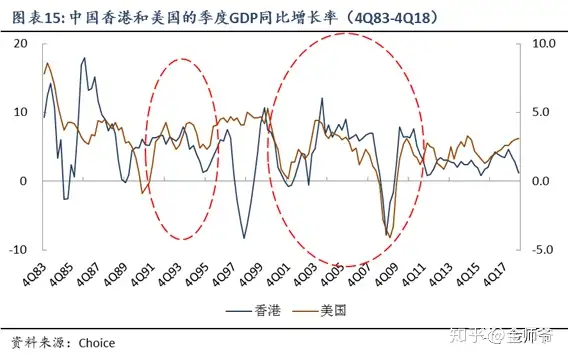
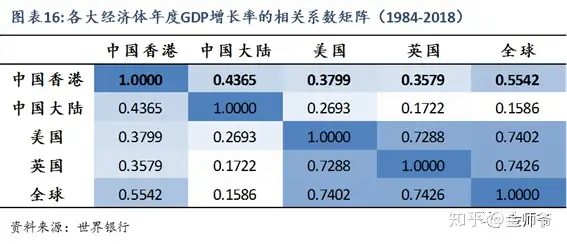
Under the linked exchange rate system, due to the lack of independence of monetary policy in Hong Kong, the monetary policy of the United States will be transmitted to the Hong Kong market, which will have a greater impact on the Hong Kong economy. Although Hong Kong's economy will also be affected by other factors, the impact of US monetary policy cannot be ignored. As a result, the economic cycles of Hong Kong and the United States are synchronized in many periods. Exhibit 15 shows that Hong Kong and the United States experienced similar economic growth in the early 1990s and the 2000s. Judging from the correlation coefficient, the economic correlation between Hong Kong and the United States is relatively high, slightly lower than that of mainland China, which is geographically interdependent. Relatively speaking, as an economy that is not fully open, mainland China has much less economic correlation with the United States. It can also be deduced from this that the independence of monetary policy in Hong Kong is lower than that in mainland China.
4.2 Easy to become the target of international speculators
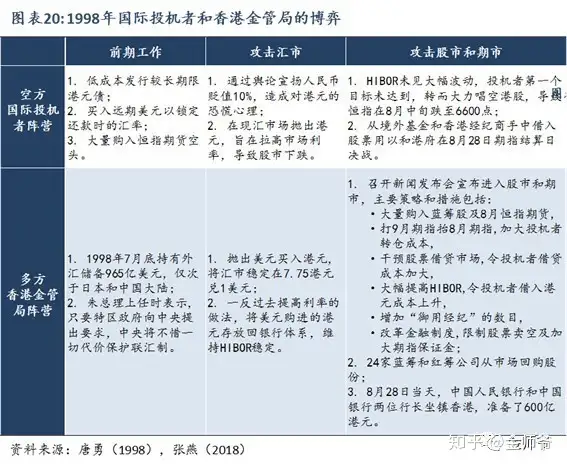
In the mature capital market, there is no lack of short-selling mechanism, but the existence of the linked exchange rate increases the risk of short-selling. Only under the fixed exchange rate system, the government will take all possible means to maintain a certain exchange rate level in order to keep its promise, and will provide conditions for cross-market linkage arbitrage, and speculators can also find "opponents", such as the British pound, Thai baht, and Hong Kong dollar. Not so (Tang Yong, 1998). Under normal circumstances, when international speculators sell Hong Kong dollars, the HKMA will sell US dollars to buy Hong Kong dollars. In order to prevent the depletion of foreign exchange reserves and to prevent international speculators from borrowing Hong Kong dollars to sell, the HKMA will tighten the monetary policy, thereby raising HIBOR. One disadvantage of this is that it reduces market liquidity, which is negative for the stock market and creates opportunities for shorting the stock market and stock index futures. International speculators saw this and attacked the Hong Kong market from three aspects: foreign exchange market, stock market and futures market.
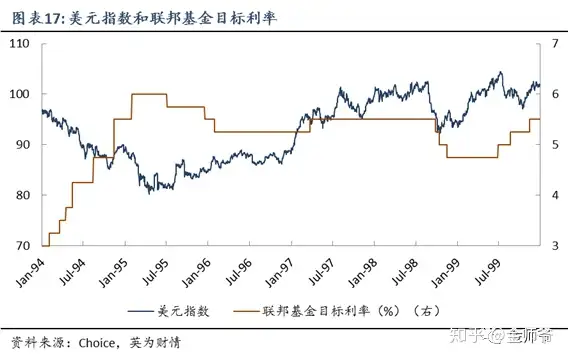
As mentioned above, when the US interest rate and the expected exchange rate of the US dollar against the Hong Kong dollar rise, in order to maintain the exchange rate stability, the HKMA must sell foreign exchange reserves. Before the outbreak of the Asian financial crisis, the fundamentals of the U.S. economy were good, the Federal Reserve raised interest rates, international capital returned, and the U.S. dollar index strengthened, which put pressure on Hong Kong to maintain currency stability.
In 1997, under the attack of international speculators, many countries in Southeast Asia were forced to abandon the fixed exchange rate system, which led to a sharp depreciation of their currencies. In October of that year, international speculators moved to Hong Kong, and the Monetary Authority adopted a traditional response method, which led to a sharp rise in HIBOR and tight liquidity. The Hang Seng Index fell by 18% in the week of October 20 alone.
In August 1998, affected by the Asian financial crisis, Hong Kong's economy was extremely depressed, the GDP growth rate plummeted, and the unemployment rate rose sharply. After lurking for several months, international speculators believed that the time was ripe, so they launched a joint attack on Hong Kong's foreign exchange market, stock market and futures market.
Fortunately, the Hong Kong Monetary Authority responded positively and adopted appropriate methods, which did not lead to a bigger crisis. In the foreign exchange market, the HKMA reversed its strategy of tightening monetary policy after buying Hong Kong dollars sold by speculators, and maintained the stability of HIBOR, thus shattering the first target of speculators. Next, the Monetary Authority withstood the pressure and entered the stock market and futures market to confront speculators head-on, which was beyond the expectations of speculators. Ren Zhigang, then chief executive of the HKMA, pointed out that the Hong Kong market had adjusted due to the attacks of speculators at that time. If speculators continued to attack, they would be manipulating the market, and the HKMA would not do so.
Although the HKMA repelled the international speculators, the price was huge. In August alone, foreign exchange reserves dropped by US$4.472 billion. Coupled with the impact of the previous financial crisis, Hong Kong's economy fell into recession and the unemployment rate continued to rise. This has to make us reflect, since the linked exchange rate has increased the possibility of the financial market being attacked by international speculators, why should it continue to be maintained?
5 Alternatives to the Linked Exchange Rate System
The Linked Exchange Rate System has indeed made some achievements in stabilizing Hong Kong's financial market, but its existence has deprived Hong Kong of its independence in monetary policy, and it has also caused Hong Kong to be repeatedly attacked by international speculators. So, are there any other alternatives? This paper considers the following four options to choose from:
Option 1, pegged to the RMB. With the continuous economic development of Mainland China and the increasing internationalization of RMB, the degree of economic correlation between Hong Kong and the Mainland is also deepening, and Hong Kong is the largest RMB offshore market. Instead of pegging the Hong Kong dollar to the U.S. dollar, it would be better to peg it to the renminbi. However, there is a premise here, that is, the renminbi has truly become an international currency. After all, the renminbi itself is now constrained by the US dollar. The peg between the Hong Kong dollar and the renminbi will be possible only when mainland China realizes full convertibility of the capital account and the renminbi adopts a floating exchange rate system.
Option two, pegged to a basket of currencies. If the Hong Kong dollar is pegged to a basket of currencies, the probability of Hong Kong's economy being affected by large fluctuations in the exchange rate and interest rates of a single pegged currency will be reduced, but the practice of pegging to a basket of currencies is more complicated and much less transparent. How to allocate the proportion of a basket of currencies will be a new issue. Moreover, the reduction in the transparency of monetary policy will affect the market's confidence in the exchange rate system.
Option three, dollarization. The total amount of foreign exchange reserves in Hong Kong is greater than the total amount of the base currency. Directly using the U.S. dollar as the currency in circulation can avoid the occurrence of attacks on the local currency. However, this will lead to legal issues such as anti-money laundering. For the Monetary Authority, not only will it lose seigniorage, but it will also completely lose its ability to control currency.
Option four is to implement a floating exchange rate system. Under the free-floating exchange rate system, the HKMA will enjoy greater freedom to implement independent monetary policies to achieve the goals of price stability or economic growth. However, Hong Kong is a highly open market and is easily affected by fluctuations in international capital flows. If a floating exchange rate system is implemented, exchange rate fluctuations will increase the uncertainty of investment and trade. Investors will be forced to use a variety of financial instruments to hedge foreign exchange risks. Increase the cost of doing business.
Many patriots want to fight with the United States, and they often read online that China should not be tolerant, and should not accommodate the United States in everything, but have you ever thought that we still have to rely on them for many things, such as Chips give us a headache, and now even OPPO has announced that it will stop chip manufacturing because it is too expensive to manufacture chips.
If it really challenges the United States, my country's chip companies will face great difficulties. This is an indisputable fact.
And if we really fight with the United States, we ordinary people will definitely suffer more, so peace comes first.
Regarding the challenge to the United States and China's manufacturing of chips, let's see what netizens say.
Netizen 1: It depends on the United States whether to fight a war with the United States. If it wants to fight, we will accompany it, but whether to fight a war or not, chips must be manufactured, let alone hundreds of millions, billions, hundreds of billions or trillions , Fujian’s subsidy must also be done, that is the key, the modern intelligent society, any field is inseparable from chips, car manufacturing, airplanes, ships, rockets, spaceships, tanks, mobile phones, computers, any automatic generation There is no machine without a chip. We must not let people get stuck on the chip.
Netizen 2: Designing chips is one aspect, and making chips is another aspect. Huawei's Kirin 9000 is naturally the only chip with the most powerful functions that integrates cpu.gpu.wifi.5g baseband. Although the CPU is not the most powerful, but the function integration Still the strongest, but because no one helped him produce it. We have top chip design technology, but not good chip manufacturing technology.
Netizen 3: I didn't study electronics and physics. If the country wants to do it, as long as the country has plans and measures, it can definitely be created. But because we gave up independent research and development prematurely, thinking that selling chips is cheaper than making chips, this is our own mistake, not how difficult the technology is. It doesn't matter if you can't do 7nm and do 14nm or 22nm, but the lower density consumer products are larger, which has no effect on industrial and military products, and the reliability may be higher. A company quits due to difficulties, but for China, it still must have its own chip production capabilities. The reason why the United States cannot rely on China's sanctions is not that we are against the United States, but that the United States is forcing us to do so.
Netizen 4: This is a threat from the United States. Based on this alone, it is absolutely necessary for China to fight the United States. The reason why oppo gave up developing chips is because if oppo continues to develop chips, the United States can impose sanctions on it, and no one can manufacture the developed chips. At the same time, it will cut off the supply of existing chips. Reluctantly give up. The more this is the case, the more it shows that China must have the determination and courage to fight the United States to the death, otherwise it will still be suppressed forever.
Netizen 5: Breaking through the chip blockade is the overall behavior of the country. It cannot be judged that the whole country is not good because of the behavior of a certain company. This is an overgeneralization. Just like when a company goes bankrupt, it means that the entire industry is in decline. Just like a charge before a battle, someone will always fall and die, but there will always be someone who breaks through the enemy's defenses and wins.
Netizen 6: Playing with chips and burning money is mainly in the experimental stage. First, small-scale production test verification is required. As long as the parameters and performance are not up to standard, electromagnetic radiation interference, parasitic oscillations caused by circuit distributed capacitance, circuit leakage, etc. Re-design, typesetting and wiring.
Oppo quit I think there are multiple reasons:
1. It is true that I have no money or strength to research chips.
2. The national chip subsidy is no longer available.
3. The national chip technology has come out and can be manufactured, so there is no need for him to study it.

香港的联系汇率制度该废除了

美国佬为了收割一定会剧烈加息,因为留给美国佬的加息窗口期已经不多了,最多到明年6月份。但从目前的形势来看,搞不好明年1月份就要退出加息周期,进入降息周期。原因很简单,美国的经济其实经受不住这么猛烈的加息。如果加息太多,美国的财政收入连利息都会还不上。现在的这些就业数据都是为了加息而造的数据,根本反映不了美国的实际经济情况。但美国要完成收割,就必须造数据,必须通过剧烈的加息引爆非美国家经济,并迫使这些国家向美国及其主导的国际金融组织求助,出卖自己国家的核心优质资产。我一直在强调,美元回流不是目的,重新出来收购优质资产才是根本目的
    由于香港实行的是联系汇率制度,叠加最近的台海局势、新冠疫情等,如果美国继续进行大幅度的加息,美元的不断流出就会爆掉香港的股市、汇市和债市。香港的外汇储备在国际资本的绞杀下根本挡不住。因此,我一直在建议香港要适时地废掉美元联系汇率制度,转而锚定人民币。未来的老大你不靠,你靠个没落的帝国,结果当然是被没落的帝国带到沟里去。但大陆及香港太多的所谓经济学家都是美国培养的,很难跳出美国所布的经济圈套。最近听说巴菲特亏了几千亿,这很正常。巴菲特本来就是西方资本的一个局,这个时候不亏,怎么割?巴菲特的资金很多都来源于国外资金(很多都是主权基金),亏了不正好么。世界上没有神,凡是过于神话,特别是过于全能且神话的都要怀疑。那个马斯克也是个大忽悠。
    现在美元即使剧烈加息,我们不会随便跟着加息。我们要逆周期操作,准备替代美元的地位。全球160多个国家站在我们身后,我们也需要保证他们的经济安全。美国玩的那套并不高明,其实很容易破解。不用美元不就行了。很多数据按美元计价本身就是个笑话,就拿俄罗斯来说,开战前GDP按美元计算才多少,开战后不久按汇率计算立马掉了8成,然后打战到现在又回去了,GDP还增加了。这不是扯淡的事情嘛。因此,我们没必要按照美国的经济理论来指导或者解释我们的经济。香港应该借此机会解开自己身上的枷锁,干嘛要随着美国佬的指挥棒而舞动。
    其实到现在,美国已经拿我们没什么办法。虽然在尖端科技方面我们确实有些差距,但问题是这些尖端科技对我们的影响很小,我们不用,我们的社会也照样正常运转。美国现在搞金融战,我们觉得香港应该站在我们自己这方,废掉联系汇率制度。虽然废掉联系汇率制度可能会造成一定的波动,但有强大的大陆做后盾不会有问题的。大陆香港的贸易可以用人民币,香港和非美盟友之间可以用人民币或者美元(大陆的美元逆差很充足)。以后香港还是全球金融中心。原因非常简单,我们的实力足够支撑。全世界200多个国家或地区,大多数国家都会站在我们这边。不要老是势利眼,占人口大多数的发展中国家发展起来,金融规模的预期不会小。干嘛一定要抱着没落帝国的大腿呢?
    全球200多个国家,站在我们这边的170多个国家如果都不用美元,美国能咋的?打?这些国家所需要的技术绝大部分我们都有,没有的其实也可有可无。论军事实力,这170多个国家干过美国及其所谓盟友也是绰绰有余。有什么可怕的呢?    
    香港是时候采取废除行动了。

 香港的货币制度该“变”还是“不变”?


曾被视为港币与金融稳定之基石的联系汇率制度会变吗?它关乎市场诸多预期。


自1983年开始,香港政府一直推行港币联系汇率制度,但行至“百年未有之大变局”的今天,这一切是否会因为政策环境、相关法律制度的变化而相应被改变?


走出“银本位”、“与英镑挂钩”时期,囿于“浮动汇率”时期之历史镜鉴而产生、运行37年的联系汇率制度——经历了1987年“股灾”、1992年欧洲汇率机制风暴、1994/95年墨西哥货币危机,以及亚洲金融危机等诸多挑战与考验,看似仍稳如磐石……


现在,这个利弊皆存的货币制度需要怎样权衡轻重?其“利”在于减少不确性、及投机资本导致的汇率波动;其“弊”则是信用承压,且缺失运用货币政策调整经济的能力。


而采取港币与美元的联系汇率制,是香港政府的选择,并非外界的安排,更无须其同意与批准。与之相仿的新加坡、卢森堡、迪拜等国际化城市就提供了相关借鉴价值。


那么,香港的货币制度该“变”还是“不变”?


这得从港币与美元联系汇率制度的基本内容与本质说起。


香港于1983年开始实行港币与美元联系汇率制度(简称“联系汇率制”)。法例规定,从1983年10月17日起,经香港金融管理局(下称“金管局”)授权的发钞银行一律以1美元兑换7.8港元的比价,事先向金管局管理的“外汇基金”缴纳美元,换取等值的港币“负债证明书”后,才能增发港币现钞,所缴纳的美元就成为港币现钞的价值储备物。发钞银行回笼并销毁港币现钞时,金管局会以美元按照1:7.8的规定比价赎回负债证明书并监督银行销毁相应的港币现钞,银行则从外汇基金收回相应的美元。


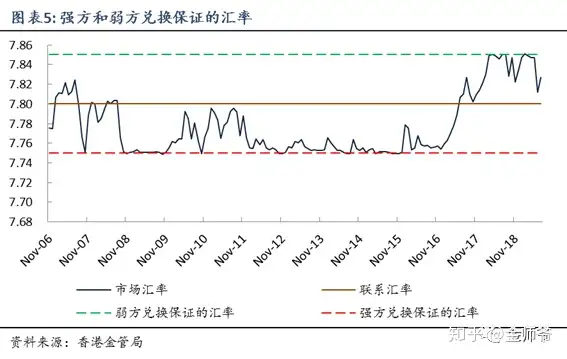
实行联系汇率制度后,维护港币与美元稳定的汇率就成为香港货币政策的唯一目标。资金流入或流出只能允许影响利率而非汇率出现超出允许范围(以7.8为基准,上下各留出0.05个基点的波动区间,即港币对美元的实际汇率允许空间为7.75至7.85)的调整。为了减少利率过度波动,金管局主要通过贴现窗口扩大或收缩资金拆放对利率进行调节。为有效应对国际资本对港币汇率的冲击,金管局于2005年推出联系汇率制度保护措施:将1美元兑换7.75港元确定为强方兑换保证汇率,即金管局保证在港元对美元转强至7.75时,按此汇率抛售美元兑换港元;将1美元兑换7.85港元确定为弱方兑换保证汇率,金管局保证在港元对美元转弱至7.85时,按此汇率以港元收购美元。


需要注意的是,港币与美元联系汇率制,直观看港币应该都是有美元作为支撑的,但实际上主要是港币现钞具有美元储备作为支撑。而在当今社会,现金并不是货币总量的全部,随着银行“记账清算”日益替代“现金清算”,随着社会移动支付的不断发展,全社会货币总量中,现金所占的比重越来越低(目前市场经济比较发达的国家和地区普遍低于4%),绝大部分货币是通过银行发放贷款或购买债券等方式投放出来的,这种货币投放主要是建立在债务人能够按照约定及时足额地还本付息的基础上,银行能够保持充足流动性以保证存款人对外支付需要的基础上,但并不是建立在保证这些货币能够完全兑换成外汇的基础上的。考虑到这种情况的存在,本质上,货币总量越大,现金所占比重越低,香港金管局维持港币与美元联系汇率制面临的挑战和压力就会越大。


由此,不得不提及的是港币与美元联系汇率制度之关系。


实施港币与美元联系汇率制度,就意味着香港放弃了独立自主的货币政策,更多地受制于美元体系的货币政策,难以充分发挥货币政策对经济社会发展与稳定的宏观调节作用。但考虑到香港主要是发展高度开放的外向型经济,重点是发展商品转口与服务贸易,以及致力于建设国际金融中心,需要更好地融入国际法律体系与货币金融体系。其中,与作为国际中心货币的美元建立稳固的联系汇率制,可以大大增强港币的国际认可度和流通性,因此,联系汇率制曾对香港的稳定与发展发挥了重要作用,其在香港回归中国前后的一定时期可能更为重要。


当然,由于香港经济毕竟不同于美国经济,所受到的影响因素也存在很大不同,当双方经济发展与金融稳定出现明显偏离时,当国际社会对两种货币的需求发生明显偏离时,要维持这种联系汇率制可能就会面临很大挑战,需要香港金管局和政府具有很强的美元储备实力、信用背书以及对货币市场乃至整个金融市场的监控与管理能力。


据香港财政司司长陈茂波披露,香港现在约有4400亿美元的外汇储备,是香港流通货币(实际是指现金)折合美元数的两倍多,较好地支撑了港元盯住美元的汇率制度。但4400亿美元外汇储备相对于超过14万亿港元(约合1.8万亿美元)的货币总量而言,也就只有25%左右,如果出现大规模的以港币兑换美元的需求,香港政府和金管局仍然可能面临巨大压力,需要提前与中国大陆央行以及其他国家央行做好美元融资的安排。


但需要明确的是,采取港币与美元的联系汇率制,是香港政府自己的选择,而不是外界的安排,也无须它们的同意与批准。实际上,这种与美元固定挂钩的联系汇率制的实施,有利于增强美元和其主权国的国际影响力,对该主权国有益而无害。当然,如果美元主权国能够予以支持(如在香港的国际贸易和金融往来上不予限制,在货币互换等方面做出支持的承诺等),就更加有利于这种联系汇率制的实施。相反,如果一个国家或地区被美元主权国列入制裁名单,其美元收付受到该国控制,这种与美元固定挂钩的联系汇率制度也许就会失去生存的基础。


所以,美元主权国可能不会直接谋求切断港币与美元的联系汇率制度,其能做的,或是加大对香港一些企业、个人、金融机构乃至政府的制裁,并通过该国控制的美元国际支付清算体系(如SWIFT)控制被制裁对象的美元收付,直至更广泛地控制美元进出香港,相应削弱港币与美元联系汇率制度的基础。


但考虑到香港已经成为重要的国际金融中心,港币发钞行包括汇丰银行、渣打银行和中国银行,美元主权国的跨国公司和金融机构乃至该国政府在香港拥有很大投资和权益,如果美元主权国贸然实施较大范围、较大力度地控制美元进出香港,不仅会对香港产生重大影响,也会对美元主权国本身和很多国家及全球金融市场造成重大影响,包括重挫国家关系乃至全球资产价格;若是,相信届时香港定会得到中央银行与政府的全力支持。


所以,除非发生特殊事件,否则,美元主权国也许不会轻易采取强力措施直接冲击港币与美元的联系汇率制度。但对美元主权国可能采取制裁措施带来的影响,仍需要做出最坏情况的应对准备。


其实,联系汇率制并非香港唯一选择。


对香港而言,采取港币与美元的联系汇率制有利有弊,而且需要非常重要的条件,包括高度开放并积极融入由美元主权国主导的国际法律体系与货币金融体系。但随着香港相关新法的正式颁布实施,欧美等国家对待香港的态度和政策正在发生深刻变化,面对当今世界日益明显的“百年未有之大变局”,香港维持港币与美元固定挂钩的联系汇率制度将面临何种挑战,其利弊关系可能发生何种变化,是否需要做出根本性调整(改变联系汇率制),已经成为不可回避的重大问题,确实需要认真仔细的考虑。


实际上,与美元固定挂钩的联系汇率制度并非香港唯一的选择。


比如,与香港类似的新加坡、卢森堡、迪拜等高度开放与国际化的城市国家或政府,就没有选择与美元或欧元等国际货币固定挂钩的联系汇率制度,而是实施独立自主的货币与政策体系,在利率与汇率管理上拥有更大协调运作空间。同在亚洲的新加坡,并未因为实施独立自主的货币政策而带来严重的负面影响,反而使其在国际竞争与货币管理上拥有更强的灵活性,其与港币相比的优势正在逐步增强而不是减弱。


这里还需要看到的是,与黄金或某种外币固定挂钩的做法本身就不符合国家信用货币发展的方向,因此,即使是美元主权国,其在1944年布雷顿森林协议确立时做出的“1盎司黄金等于35美元”的承诺,到1971年也被迫放弃。


所以,无论从应对国际局势深刻变化以保持香港货币与金融体系稳定考虑,还是从新加坡等国独立自主货币政策的实践效果看,香港可能都有必要认真考虑港币与美元联系汇率制度何去何从——是否需尽快转化为独立自主的货币体系?并且拿出必要的实施方案。


从具体运作上看,也许调整港币与美元固定挂钩的联系汇率制度并不是很难做到的转变。似乎金融管理局可以承担香港中央银行的职责,并通过改变与发钞行的债权债务关系,将其缴存的“外汇基金”转化成为直接归金管局所有的外汇储备(相对货币总量而言,香港的外汇储备规模较大)。当然,调整与美元的固定挂钩联系汇率制度,转为独立自主的货币与政策体系,需要香港金管局要像新加坡金管局一样,切实增强货币兑换与金融市场的监控以及利率、汇率管控的能力。

四十九次出手的底气 

5月4日,香港金管局出手承接46.71亿港元沽盘,这是香港金管局2022年5月以来第49次出手购买港元,累计买入2900多亿港元,使港元对美元汇率稳定在7.75至7.85的区间内,有力维护了香港联系汇率制度的稳定。

香港是高度开放型的经济体,不设外汇管制,因此维持汇率稳定非常重要。自1983年以来,香港实行联系汇率制度,即发钞银行一律以1美元兑换7.8港元的比价,事先向外汇基金缴纳美元,换取等值的港元“负债证明书”后,才增发港元现钞。同时政府承诺港元现钞从流通中回流后,发钞银行同样可以用该比价兑回美元。香港回归祖国后,基本法授权香港特别行政区政府自行制定货币金融政策,保障金融企业和金融市场的经营自由,并依法进行管理和监督。 基本法第112条明确规定香港不实行外汇管制政策,资金自由流动。
49次出手,是对联系汇率制度设计的坚定执行。联系汇率制度下,如果市场对港元需求增加,港元汇率升至7.75港元兑1美元的强方兑换保证水平,金管局会应银行要求买入美元卖出港元,使银行体系总结余增加及港元利率下跌;如果市场对港元需求减少,港元汇率降至7.85港元兑1美元的弱方兑换保证水平,金管局会应银行要求买入港元卖出美元,使银行体系总结余减少及推高港元利率。两种操作目的都是使港元对美元汇率稳定在7.75至7.85的区间内。

在联系汇率制度下,港元利息水平一般会接近美元利息水平,但也会受到本地市场港元资金供求的影响,在现实中并不会随时同幅跟进美元利息,这样就产生了套利空间。美国2022年3月进入加息周期,由于美元利息高于港元,诱发市场套息交易,即以较低利率贷出港元,然后换成利率较高的美元,赚取利差。套利活动导致港元汇率屡屡触及弱方兑换保证水平,香港金管局随之出手购买港元。
49次出手,是香港金融及银行体系强大韧性的展示。截至今年4月底,香港外汇储备资产为4274亿美元,相当于香港流通货币规模的5倍多,相当于港元广义货币供应的40%。此外,银行持有的外汇基金票据及债券超过1.1万亿港元,在有需要时可随时以这些外汇基金票据及债券作为抵押品,通过金管局获取港元流动资金。

香港金管局每一次出手购买港元都意味着等量数额的资金流出港元体系,体现为香港银行体系总结余的降低。到5月5日,香港银行体系总结余降至445.27亿港元,创2008年11月以来的新低。但资金流出港元体系不等于流出香港,当前香港银行体系存款总额保持平稳,整体存款自去年4月底至今年3月底增长了约1.4%。

49次出手,是香港发挥“背靠祖国、联系世界”独特优势的体现短期资本可以从暂时的息差中套利,长期资本更注重经济基本面。对国际投资者而言,香港与内地经济的良好发展态势是最大红利。在1997年亚洲金融危机和2008年国际金融危机发生时,内地坚定支持香港维护联系汇率稳定的决心令全世界印象深刻。背后有一个强大的祖国,就打消了很多投机资本兴风作浪的企图。港元汇率多少次触及兑换保证,金融监管部门就多少次出手入市,任何人都不会有趁机“击穿”香港金融体系的幻想。

5月5日,国际货币基金组织表示,联系汇率制度仍然是维护香港宏观经济及金融稳定的最合适安排。历经风雨,香港的联系汇率制度稳健无虞,香港长期繁荣稳定的态势不变。


1 联系汇率制度的背景

1.1 联汇制在香港的确立

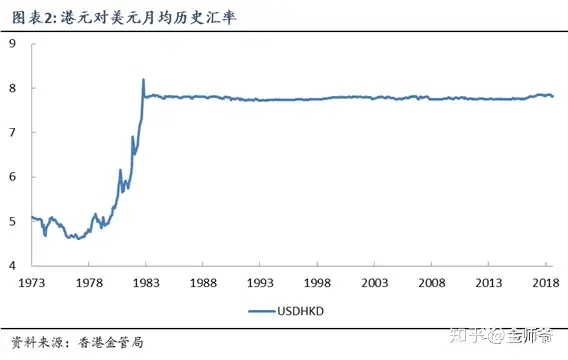
1863年,香港政府宣布当时的国际货币银元为香港的法定货币,并于1866年开始发行香港自己的银元。1935年的白银危机令香港放弃银本位制,并按16港元兑1英镑的汇率将港元与英镑挂钩,《货币条例》要求银行向外汇基金交出支持纸币的所有白银,以换取负债证明书(基础货币的一种),外汇基金则把这些白银投资于英镑资产,香港开始实行货币发行局制度(Currency Board Arrangement,又作货币局制度,笔者注:英国曾在其殖民地大规模实行此汇率制度)。1972年6月,布雷顿森林体系崩溃后,英国决定让英镑自由浮动。其后,港元曾一度与美元挂钩,最初是5.65港元兑1美元,后于1973年2月改为5.085港元兑1美元。1974年11月,由于美元走弱,港元遂改为自由浮动。

虽然浮动汇率制度刚实施后运作颇为顺利,但其后的情况却并不理想。由于当时香港的货币政策架构尚不健全,香港经济陷入了动荡期,1975年GDP增长率为负0.3%,1976年却上升至16.2%,通胀水平从1975年的2.7%大幅攀升至1980年的15.5%。投机狙击活动,以及对香港前景的信心危机加剧,令港元贬值的情况进一步恶化,1983年9月,港元汇率在两日间贬值13%,汇率由1981年的5.13港元兑1美元,贬值到了1983年的9.60港元兑1美元。

面对货币危机,为了打消市场对相关银行稳健问题的疑虑,香港政府在1983年10月15日公布新政策,以稳定港元汇率,将港元按7.80港元兑1美元的固定汇率与美元挂钩。这项安排成为了香港目前的联系汇率制度的基础。

1.2 国际上的货币局制度

IMF当前采用2009年更新的汇率制度分类,主要的汇率制度为硬钉住汇率制、软钉住汇率制和浮动汇率制,香港所称的联系汇率制度属于货币局制度,是硬钉住汇率制的一种。

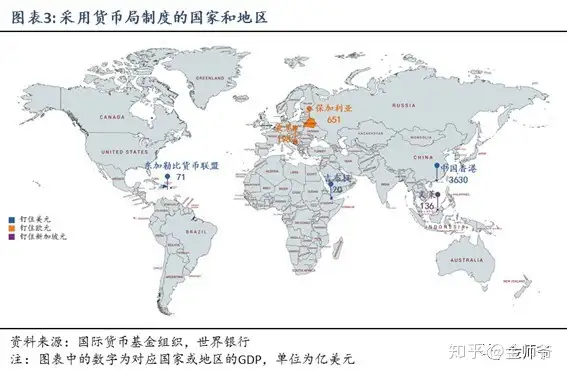
根据IMF最新的《汇兑安排与汇兑限制2018年报》的划分,当前仍采用货币局制度的国家和地区共有11个,包括中国香港、吉布提、保加利亚、文莱、波黑和东加勒比货币联盟(6个)。从数量上看,比1960年少了17个。从经济规模上看,这些都是小型经济体,其他10个国家和地区的GDP之和还不足香港的三分之一。

2 联系汇率制度的内容

2.1 外汇储备

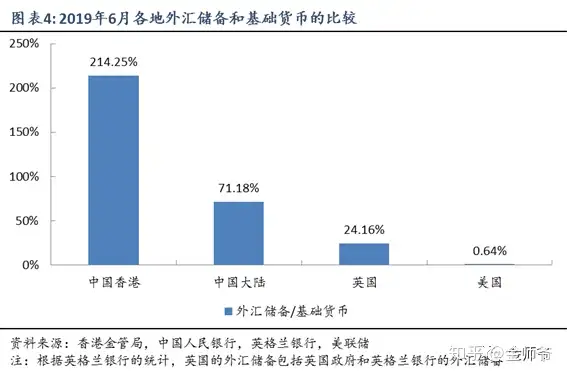
根据香港金管局的定义,香港的联汇制属于货币局制度。在这种制度下,基础货币的流量和存量均需要得到外汇储备的十足支持。即,基础货币的任何变动都必须有外汇储备按固定汇率计算的相应变动完全配合。这就要求香港的外汇储备必须不少于基础货币。而在其他几种汇率制度下,各大央行可以通过买入国债等资产来发行货币,采用软钉住汇率制的中国大陆和采用浮动汇率制的英美的外汇储备都少于基础货币。特别是美国,由于美元是最流行的储备货币,其外汇储备几乎为零,这大大提高了其货币政策的独立性。
2.2 兑换范围

除了在发行基础货币时按照1美元兑换7.8港元的固定汇率之外,金管局还在7.8港元上下500个基点限定了兑换范围。2005年,金管局推出了强方兑换保证,承诺会在7.75港元对1美元的汇率水平时从持牌银行买入美元并卖出港元,并宣布将1998年制定的弱方兑换保证的汇率水平由7.80港元调整至7.85港元,在达到这一水平时卖出美元并买入港元。由此,金管局将汇率限制在7.75-7.85的区间内,维持港元币值的相对稳定。
2.3 利率调节

在联汇制之下,资金流动会导致利率的变动,而汇率则保持稳定。当资金流入,市场人士向银行买入港元,银行向金管局出售美元以换取港元,基础货币增加,令香港利率下降,降低港元的吸引力,自动抵销资金流入的影响,反之亦然。可谓是一个自动的调节机制。

为了减少利率过度波动,金管局会通过贴现窗提供流动资金。其当前的基本利率的确定方法为,取美国联邦基金利率目标区间的下限加50个基点,或隔夜及1个月香港银行同业拆息(HIBOR)的5天移动平均数的平均值的较高者。
3 联系汇率制度的理论基础

3.1 三元悖论

“三元悖论”指出,在开放经济中,一个国家或经济体不可能同时实现三个目标——货币政策的独立性、汇率稳定和资本自由流动——只有两个目标可以同时实现。香港是国际金融中心,其经济自由度指数25年蝉联全球榜首,国际资本可以自由流动。那么,政策制定者只有在汇率稳定和货币政策独立性两者之间抉择。金管局指出,香港属高度外向及开放型经济体系,商品及服务贸易总值约相当于本地生产总值的三倍,因此维持港元汇率稳定非常重要。前文中也提到它选择联汇制前港元面临了较大的贬值压力,既然它选择了汇率稳定,也就同时放弃了货币政策的独立性。像这样严格的汇率体系会剥夺这个经济体所需的灵活性,特别是面临金融危机时——中央银行必须扮演最后贷款人角色的时候(克鲁格曼,2006)。
3.2 货币政策图解分析

3.2.1 应对美国利率水平变动

“三元悖论”中指出,在货币局制度框架下,金管局没有货币政策独立性。在此情况下,为了维持汇率E0(以直接标价法计)不变,港元的利率会跟随所盯住的美元的利率而变动。当美国利率水平上升至R*2时,美元存款的港元收益相应上升,图表9上方的曲线右移R*2- R*1。然而,这时香港的利率仍维持在R*1,低于新的美元资产的预期收益。这一差别会引起外汇市场上对美元资产的超额需求,为继续使汇率保持在E0,金管局必须出售外汇储备以收缩港元供给。一旦货币供给降到M2时,货币市场达到均衡点,外汇市场出清(点2),利率为R*2。此外,从美元存款的港元收益公式中看,预期汇率E0的变动也会有类似的效果,当市场显示香港可能无法维持固定汇率时,港元贬值预期(美元升值预期)也会使上方的曲线右移,金管局也只能采取收缩货币供给的措施。
3.2.2 应对本地区国民收入水平变动

对内而言,金管局同样无法采取以本地区目标为导向的货币政策。图表10中显示,在联汇制下,汇率固定在E0,港元利率等于美元利率R*。当香港的国民收入水平Y1增加到Y2,实际货币需求相应增加。如果金管局不采取行动,那么货币市场就会在点3达到新的均衡。由于点3的利率高于R*,港元汇率具有从点1'到点3'的升值倾向。在联汇制下,金管局不会允许港元升值,就会被动购入美元资产投放港元,使货币供给增加。结果在货币市场新的均衡点(点2)上,本国利率再一次等于R*,从而维持了汇率的稳定。然而,在经济持续增长时,不采取紧缩的货币政策可能会导致通货膨胀。
4 联系汇率制度的挑战

4.1 没有独立的货币政策

上文从理论角度分析了在联汇制下,金管局在应对美国利率水平和本地区国民收入水平的变动时难有作为。结果是其无法根据本地区经济发展情况自主制定合理的货币政策,反而受到美国经济环境制约,从而使美国的货币政策传导到香港。下文将从利率调整、外汇干预、逆周期调节和经济周期四个角度说明联系汇率存在的问题。

4.1.1 被动调整基准利率

从图表11的分析可知,当美国利率水平发生改变时,香港需要采取相应的行动,跟随美国同向调整利率。当前的香港贴现窗基本利率的确定方法为,取美国联邦基金利率目标区间的下限加50个基点,或隔夜及1个月香港银行同业拆息的5天移动平均数的平均值的较高者。从其走势上看,基本上保持与美国联邦基金利率目标一致,只是在大部分情况下略高。
每当美联储改变基准利率,金管局除了立即做出相应的调整之外,其总裁还会发表演讲阐述美联储改变基准利率的原因,香港当前的利率水平和和对香港经济的影响。这说明香港的货币政策十分依赖美国,没有独立性。

4.1.2 被动干预外汇市场

上文中提到,金管局将汇率限制在7.75-7.85的区间内。当汇率水平达到兑换保证水平时,金管局必须被动地干预外汇市场,改变港元的供给水平,限制汇率的大幅波动。根据IMF的整理,从2007年到2018年,港元汇率接近强方兑换保证的频率更高,故而金管局多次采取买入美元并卖出港元的市场操作,以防止港元过度升值。可见,只要市场汇率偏离目标固定汇率,金管局只能被动干预外汇市场,调整本外币的供给。
4.1.3 削弱逆周期调节能力

上文中提到,金管局为了维持汇率稳定,必须将利率水平与美国保持一致,由此无法根据本地区的国民收入水平采取合理的货币政策。我们考虑到逆周期调节的货币政策存在3个季度左右的滞后期,对图表进行相应调整,比较GDP增长率和基准利率的关系。图表13中显示,美国的联邦基金目标利率和GDP增长率的走势相当一致,可见,美联储可以根据经济增长情况自主地采取货币政策。然而,图表14中显示,香港的贴现窗基本利率和GDP增长率的走势有些时段是相背离的。从1997年4季度到1999年2季度,受亚洲金融危机影响,香港的GDP增长率下降,甚至出现了经济衰退的迹象,但贴现窗基本利率一直处于高位。2001年“9·11”事件对香港经济的冲击甚至大于美国,此时的货币政策亦难以刺激经济。而在2008年全球金融危机后,香港经济复苏较快,2010年的GDP增长率大于6%,而贴现窗基本利率却处于低位。从这三个时段的贴现窗基本利率和GDP增长率的关系可以反映金管局缺乏逆周期调节能力。
4.1.4 经济周期与美国高度相关

联汇制下,由于香港缺乏货币政策的独立性,美国的货币政策会传导到香港市场,对香港经济影响较大。尽管香港经济也会受到其他因素的影响,但美国货币政策的影响不容忽视,其结果是使得香港和美国的经济周期在许多时期上同步。图表15中显示,在上世纪90年代初期和本世纪第1个十年中,香港和美国的经济增长情况是相似的。从相关系数看,香港和美国的经济相关度较高,略低于在地理上相依的中国大陆。相对而言,中国大陆作为一个并非完全开放的经济体,与美国的经济相关度就低得多。由此也可以反推出,香港的货币政策独立性低于中国大陆。
4.2 容易成为国际投机者的攻击目标

在成熟的资本市场中并非缺乏做空机制,只是联汇制的存在加大了做空的风险。只有在固定汇率制下,政府才会为了信守承诺采取一切可能的手段维持一定的汇率水平,才会为跨市场的联动套利提供条件,投机者也才能找到“对手盘”,英镑、泰铢、港元莫不如此(唐勇,1998)。在正常情况下,当国际投机者抛售港元时,金管局会卖出美元买入港元。为了防止外汇储备耗尽,抑制国际投机者借入港元进行抛售,金管局会抽紧银根,从而拉高HIBOR。这样做的一个坏处是,减少了市场流动性,对股市是利空的,为股市和股指期货的做空创造了机会。国际投机者正是看到了这一点,才从汇市、股市和期市三个方面攻击香港市场。

上文中提到,当美元利率和美元兑港元预期汇率上升时,为了保持汇率稳定,金管局必须卖出外汇储备。在亚洲金融危机暴发前,美国经济的基本面向好,美联储加息,国际资本回流,美元指数走强,这对香港维持币值稳定造成了压力。
1997年,在国际投机者的攻击之下,东南亚多国被迫放弃固定汇率制,从而导致本币大幅贬值。当年10月,国际投机者转战香港,金管局采取了传统的应对之法,导致HIBOR急剧上升,流动性吃紧,仅10月20日当周恒指就跌去18%。

1998年8月,受到亚洲金融危机影响,香港经济极不景气,GDP增长率急转直下,失业率大幅上升,恒指已经从1997年8月的16820.30点高位下泻到不足8000点。在埋伏了数月之后,国际投机者认为时机已经成熟,于是,对香港的汇市、股市和期市展开了联合打击。

幸好金管局积极应对,方法得当,才没有导致更大的危机。在汇市,金管局在买入投机者抛出的港元后,一反收紧银根的策略,维持了HIBOR的稳定,从而使投机者的第一个目标破灭。接下来,金管局顶住压力,进入股市和期市正面迎击投机者,这出乎了投机者的意料。时任金管局总裁的任志刚指出,当时香港市场已因投机者的攻击做出了调整,如果投机者继续攻击,就是在操纵市场,金管局也是不得以而为之。
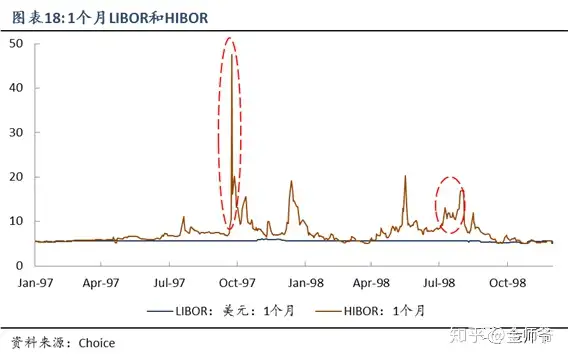
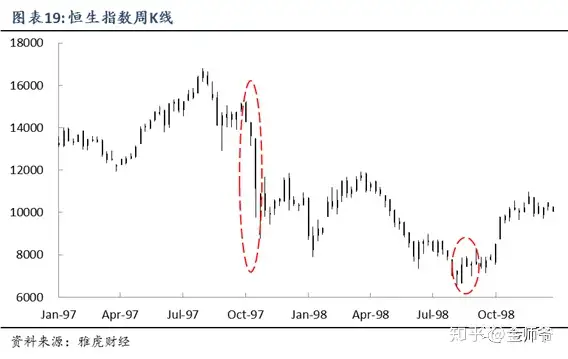
虽然金管局击退了国际投机者,但是其代价也是巨大的。仅8月外汇储备就下降了44.72亿美元,加上前期金融危机的影响,香港的经济陷入衰退,失业率持续上升。这不得不让我们反思,既然联汇制增加了金融市场遭受国际投机者攻击的可能性,那么为何要继续维持呢?

5 联系汇率制度外的其他方案

联汇制在稳定香港金融市场方面的确有所建树,但是它的存在使香港失去了货币政策的独立性,也使香港屡遭国际投机者攻击。那么,是否还有其他的替代方案呢?本文认为有以下四个方案可供选择:

方案一,与人民币挂钩。随着中国大陆经济不断发展,人民币国际化程度不断提高,香港与大陆之间的经济相关程度也在加深,香港又是最大的人民币离岸市场。与其让港元与美元挂钩,倒不如让其与人民币挂钩。不过,这里有一个前提,就是人民币真正成为国际货币,毕竟现在人民币本身也受到美元的牵制。只有当中国大陆实现资本项目完全可兑换,人民币实行浮动汇率制之后,港元才可能与人民币挂钩。

方案二,与一个篮子货币挂钩。如果港元与一篮子货币挂钩,香港经济受单一挂钩货币的汇率及利率大幅波动影响的概率就会减少,但与一篮子货币挂钩的做法却更为复杂,透明度也低得多。如何分配一篮子货币的比重,将是一个新的问题。而且货币政策透明度的降低,将会影响市场对汇率制度的信心。

方案三,美元化。香港的外汇储备总量多于基础货币的总量,直接以美元作为流通货币可以避免本币受攻击的事件发生。不过这将会引发反洗钱等法律问题,对于金管局而言,不仅会失去铸币税,还会完全失去对货币的管控能力。

方案四,实行浮动汇率制。在自由浮动的汇率制度下,金管局将享有更大的自由度,可推行独立的货币政策,以达到价格稳定或经济增长的目标。但香港是高度开放的市场,容易受国际资金流向波动的影响,如果实行浮动汇率制,汇率波动会增加投资及贸易的不确定性,投资者会被迫运用多种金融工具来对冲外汇风险,提高营商成本。

很多爱国人士都希望跟美国干一场,也经常看到网上说中国就不该忍让,不该事事都迁就美国,可大家有没有想过确实有很多东西我们还是要靠他们的,就比如芯片 ,就让我们很头疼,现在就连OPPO都宣布停止芯片制造了,原因是制造芯片太烧钱。

如果真的跟美国叫板,我国芯片企业会面临着很大的困难的,这个是不争的事实。

而且真的跟美国打起来了,我们老百姓肯定会更苦,所以和平第一。

关于跟美国叫板和中国制造芯片这事,看看网友们怎么说。

网友1:跟美国打不打仗,那要看美国,它要打,我们也奉陪,但打不打仗,芯片是必须要造的,别说几亿,几十亿,就是几千亿上万亿,闽家补贴上去也必须搞,那是关键中的关键,现代智能社会,任何领域也离不开芯片,造车,飞机,船,火箭,飞船,坦克,手机,电脑,任何一台自动代机器,有哪样离得开芯片,我们在芯片上绝不能让人卡脖子。

网友2:设计芯片是一个方面,制作芯片又是一个方面,华为的麒麟9000目前自然是唯一整合cpu.gpu.wifi.5g基带的功能最强芯片,虽然cpu已经不算最强,但功能整合还是最强,但苦于没人帮他生产出来。我们有顶级芯片设计技术,但没有好的芯片制造技术。

网友3:不是学电子和物理的。如果国家要做只要国家有计划有措施,肯定可以造出。但是由于我们过早放弃自主研发,以为卖芯片比造芯片便宜,这是我们自己犯了错,而不是技术有多难。做不了7纳米做14纳米22纳米没什么关系,不过是密度低些消费类产品体积大些,对于工业品和军工没啥影响,可靠性可能还高些。一个企业由于困难不做了,但对于中国还是必须有自己的芯片制作能力。美国制裁中国所以不可以依靠,不是我们反美而是美国逼我们不得不反。

网友4:这是美国的威胁。就凭这一点,中国完全有必要和美国一战。oppo之所以放弃研发芯片,就是因为,如果oppo继续研发芯片,美国可以对其实施制裁,研发出芯片没有人可以制造,同时对现有芯片进行断供,oppo没有像华为过硬的底气,不得不忍痛割爱。越是这样越说明中国要有与美国鱼死网破的决心和勇气,否则还是永远受打压。

网友5:突破芯片封锁是国家的整体行为,不能因为某个企业的行为就判定整个国家就不行,这是以偏概全。就像一个企业倒闭了,就代表整个行业都衰败了。就像战前冲锋一样,总会有人会倒下牺牲,但也会有人冲破敌人的防线获得胜利。

网友6:玩芯片烧钱,主要是在于实验阶段,先要小规模的生产测试验证,只要参数和性能不达标,电磁辐射干扰,电路分布电容引起的寄生震荡,电路的漏电等等,又得重新再来设计,排版布线。

Oppo退出我觉得有多个原因:

1.确实自己没钱没实力研究芯片了。

2.国家芯片补贴拿不到了。

3.国家芯片技术已经出来了,能制造了,也就不用他研究了。

评论

此博客中的热门博文

The Ultimate Tool Stack for AI Agents

弦线驻波